Early GL/yuri/lesbian games, part 1: J-PC porn era
Being irrationally interested in the question of what was the First Yuri Game, I thought being able to read Japanese would make this a simple question, but my naïveté crashed against a messy reality—how much queerbaiting does it take to count something as “lesbian”? how much subtext do I need to assume text? what to do which games that are very obviously sapphic but the author dismisses the notion? are adaptations toned down from a textually yuri original media still yuri? Are porn games made by-men-for-men yuri? if your answer is “no”—how many of the alleged men are closeted trans women? is an empty field of grass the yuri of absence? What even is “yuri” anyway?
Anyway, I'm jotting down my discoveries so far before I forget them.
The way this list ended up is; in this first part I summarise what I found about porn games I never played, from the late 1980s to the early 1990s; in Part 2 I talk about console games with non-pornographic sapphic content from the late 1990s, including my own memories/reviews of those I played back in the day.
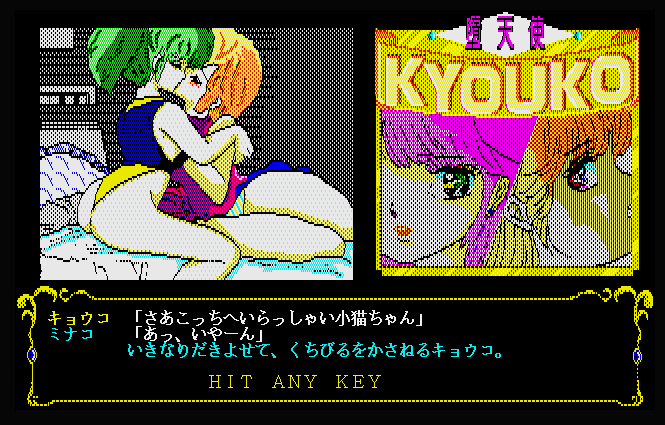 Kyōko: “Here here, kitten, come…” (Datenshi Kyōko, 1988).
I feel like the NEC PC-88/Sharp/MSX/etc. culture is the true birthplace of what we call “console” or “Japanese” videogame style, and it's also a predecessor of today's indie scenes, having considerably more artistic freedom than the children-oriented videogame consoles. Alas, in the realm of queer issues, that artistic freedom basically meant porn; I don't think there ever was a Japanese “activist game” like Caper in the Castro (1989) or The Warden Game (1987) (which even in the West were exceptional at this time). There's lots of talk online that titillation-oriented lesbian content was common in the NEC-PC scene, but it's hard to find a discussion from a queer point of view of the specifics. For many games I have trouble finding reviews or comments at all, in Japanese inclusive. None of the studios cited was specialised in yuri or queer content, or otherwise explicitly involved in Japanese queer culture. Many of the writers credited are obscure or of ambiguous gender; whenever I could confirm female writers, I've noted them down. I couldn't find any out-of-the-closet lesbian writers for 80s or 90s lesbian games.
I feel like there’s no point listing here every single porn vignette where girls squeeze breasts together (for that, look up the relevant tags on VNDB and order by year). Instead, I tried to highlight ones I found of particular interest for historical or queer reasons. These were found from a more or less random sampling of advgamer, VNDB, Moby, yuri-ge matome, the LGBTQ Video Game Archive, and web searches. Notice that none of these sources are complete, and there may be hidden gems not yet tagged as “girl's love” anywhere.
I don’t want to sound like I hold erotica in contempt—even lesbian porn made for men can be meaningful for budding sapphic women (what is sometimes called “the lesbian gaze”), not to mention the exploration of transgender feelings in male-assigned folk; and the marginality of porn as a medium can sometimes allow for topics that would be impossible to publish at the time anywhere else, such as free love, gender fluidity or homoaffective relationship dynamics. It should be noted that lesbian porn was perceived as gayer at this time than it is now—I remember boys mocking one another and questioning what's the point of watching porn without a character to identify with, are you queer or something? It's hard to imagine now, but in my corner of the world even a man who does oral sex on women was seen as kinda gay and unmanly, more or less like heterosexual pegging is still seen among the straights. This level of otherness sometimes led to porn characters that were attempts at representing actual lesbians.
Or the lesbian porn could be no more than unimaginative, non-empathetic, objectifying baseline slop, of course. (Not shaming you if you consume that either, I mean, have you seen girls??)
Ideally I would play through all of these games and review them properly, but I ain't got the time for that, so I'm summarising from youtube clips and reviews that others wrote about the games. Ideally I would interview some older queer women who played Japanese PC games at the time and ask how it felt, but this is very hard to find (I'm in my 40s and these games were still before my time). If you have any suggestions of games for this list, or the console list, or played them back in the day and want to share experiences, do send me a note!
Datenshi Kyōko (1988, System House OH)
The oldest yuri game I could find so far. You're a fallen angel whose mission is to help stressed out women relax; no plot, you start in bed right away with the heroine Minako. This is part of a “sexy voice” series, where the then-novel voice samples were the main appeal; alas the low-quality samples sound grating and anything but sexy for a modern audience. The other games in the series are unrelated and not yuri. It is interesting to me that Kyōko seducing Minako calls her koneko-chan (“kitten”), as this is lesbian slang for bottoms, and usually the yuri world is so divorced from actual lesbian culture.
Nothing in the game’s marketing or packaging suggests to me that it was seen as a landmark or breakthrough by virtue of yuriness. I presume the yuri erotica genre of pornography was already well-established in manga and other visual media, and for System House OH to have one of their many ero titles be about girl-on-girl must have been felt as ordinary.
Kindan no Paradise (1989, Studio Angel)
There's many games with erotic fantasy premises like this one, so I picked a random representative to illustrate their energy: Girl drifts into an island where two Amazon tribes are competing to choose the new queen. She throws her hat into the contest, which I am told involves “extracting the love dew of the goddess”.
Saotome Gakuen series (1989, Studio Angel)
Starting with Kokuren Uchuugun Shikan Gakkou Saotome Gakuen Nyuugaku Annai (Military Academy of the U.N. Space Force: Admission Guide). Women who pilot giant robots and hook up with one another (the U.N. mecha pilot school is female-only, natürlich). Feels like it was meant to be a long series, but I think they only ever produced this one and Blue Wind. Reportedly not much plot, but it's curious to see the like, prehistoric ancestor of the (awesome) sapphic-mecha-pilots VN Heaven Will Be Mine (2018).
Trilogy Kuki Yōka Shinden (1989, Hard Soft)
An interesting piece that sadly fizzled out. Set in the Meiji era, it's about the intrigue between two competing clans; the art and writing give me an impression of a dense dramatic historical fantasy piece, of shady politics and sword-wielding assassins, with yuri scenes in there somewhere. But this was just the short prologue of a series that would never continue.
Belloncho Shintai Kensa ~Joshikoukou Hen~ (1990, Hard Soft)
Though this type of schoolgirl erotica is kinda creepy even for ecchi anime standards, I'm listing it here due to a number of interesting traits. The artist and writer both are women (Sapporo Momoko (website) and Naha Yūko), the earliest I’ve confirmed so far. The game is high effort, with delicate art, minigames, and RPG battle mechanics—at an era when RPGs not in fantasy settings were still a novelty. Unusually for games this age, it has an English fan translation by Nana. Opponents are mostly girl delinquents, making this possibly the first game in history involving sukeban lesbianism. For some reason it's not tagged yuri on VNDB; and for some reason there's not much information about this title in the Japanese Internet (even though Momoko became well-known, and is—impressively—still doing work in adult game illustration and music).
Charm (1992, Psytech)
Charm is unabashedly a porn-oriented title—it's about a schoolgirl fantasising about such partners as her half-sister or her teacher, standard erotica material rather than queer rep. However it's notable for having stories deal at length with romance and emotions in the relationships, rather than just sex, while staying 100% sapphic. advgamer says that's highly unusual for the era. The game was a pure visual novel (it might in fact be one of the first games to call itself a “novel”, ノベルズ, by name—specifically a “disc novel”), but both the art and the writing aged well. Three writers, not credited for any other games. Had a sequel in 1994.
Two generations later, the next big landmarks in the history of GL VNs are probably:
- Akai Ito (2004), for being not erotica at all but a long, dark, serious tale focusing on emotional gravitas between girls, in a Gothic-horror-Japanese-aesthetics setting;
- Solfege (2007) and Akai Ito's successor Aoi Shiro (2008), which went beyond Akai Ito's “Class S” relationships to have, at long last, non-queerbaited lesbian relationships in all-ages videogames;
- Kindred Spirits of the Roof (2014), which despite being in the traditional male-oriented yuri erotica market, took so much care with the depiction of lesbian coming out experiences that it accrued a following among queer women;
- and the Flowers series (2014 onwards), which is a non-porn-oriented, purely emotional yuri VN written by a woman (Shimizu Hatsumi) with a female audience (also) in mind, inspired directly by the popularity of the Maria-sama ga Miteru light novels.
But these are some of the most famous entries in the history of yuri and are all well-discussed elsewhere, so let’s turn instead to the strange time in-between, from 1995 to '99, on Part 2: the console era.