Early GL/yuri/lesbian games, part 3: Lady Asellus, or the terror of becoming like men
I've been drawn to the yuri scenario in SaGa Frontier (1997) for almost three decades. I realise my strong feelings about her are in part because we had so little going on back then—Asellus was a formative experience, and not just for me; finding some actual representation for our confused experiences was a landmark for many a young lesbian gamer. But I do think this story is a landmark for more reasons than mere nostalgia; for one thing, it's one of the first sapphic scenarios ever written by a woman in this medium, in an era when much tamer stuff was heavily tabooed both in Japan and abroad; it was written as a direct challenge of sexist tropes in videogames, 17 years before Gamergate; it discusses the psychology of sapphic desire, beyond the dehumanising trope of “the pure-hearted bond between pure girls of purity who love purely”; and I am fascinated even by the twists and turns of mask-and-signal in this game, by the way a super obviously overtly sapphic character is still prevented from stating it out loud, the way the game must come up with an excuse for plausible deniability—despite this very type of queerbaiting being called out in the game itself (Zozma MVP \o/), many years ahead of when yuri culture collectively took to question the implications of “Class S” relationships.
Asellus' drama as a half-Mystic is that of being the only one of her kind, and here in the real world, too, she's an alluring anomaly; like the gothic court of Château Aiguille, she stands as a piece of liminal art, outside the flow of time.
So when I was writing the brief history of early yuri in console games, the Asellus analysis section grew more and more and accrued author quotes and etymological footnotes and whatnot, until it was way bigger than the entire rest of the post. I have therefore given Asellus her own glass coffin… I mean, her own entry in the blog series.
](https://files.transmom.love/yurige-pt2/asellus.jpeg) Zozma the rebel yōma: “Surely the fact that you are so devastated by her absence only proves how much you love the Princess.” Asellus: “Yes… as a friend! She was like a sister to me!” Denial is a hell of a drug—but Zozma won’t be having any of it…
Zozma the rebel yōma: “Surely the fact that you are so devastated by her absence only proves how much you love the Princess.” Asellus: “Yes… as a friend! She was like a sister to me!” Denial is a hell of a drug—but Zozma won’t be having any of it…
Updates to this text
- 2026-03-15: Elaborated more on the translation of Princess Golden Lion's statements
- 2026-03-16: Added link to author's page for Yasōkyoku.
- 2026-03-18: Added a much longer discussion on the idea of Asellus' “true ending” in the foonotes, and a new footnote on the idea that Asellus×White Rose supposedly are “canonically not an item”.
What the Heck are you talking about anyway what is this “Sega” video game
SaGa is Squaresoft's odd cousin to the celebrity series, Final Fantasy. Like other entries in the series, SaGa Frontier is ambitious and creative with its game systems—seven distinct but interconnected stories; open world exploration; level-less powerup system where you grow in battle by perfecting the skills you actually use; four different species with fully distinct mechanics, etc. Like many other entries in the series, SaGa Frontier fails at its ambitions and is not, like, good, if I'm honest. But it fails because it was willing to take risks and break formulas, meaning it fails in interesting ways; and it succeeds in evoking a distinct, otherwordly atmosphere. The gameplay systems are baroque, mystifying, and for all their iconoclasm the grinding isn’t any less boring than other traditional RPGs (though I do find its rhythms oddly hypnotic, and get lost in the game for a week every time I touch it); the open world concept was not technologically feasible yet, and the various worlds feel small and constrained, like theatre sets; the lack of linearity in a plot-oriented game makes the pacing end up all over. A large cast of colourful characters joins your quest, only to prove unrelated to the plot and say nothing for the rest of the story.
Moreover SaGa Frontier was notoriously rough at edges, published rushed and unfinished, with many elements that suggest something but go nowhere; doors that are clearly meant to be interactive but never open, worlds you can never visit, strange characters you meet once and never see again. By accident, this reinforced the haunting ambiance and atmospheric appeal. The jank is a feature, as the saying goes. Much of this unfinished content has been restored in the remaster; I'm not sure if always for the better.
So I do not particularly recommend this game to modern players in general, who have so many better RPGs to play—we’re in a golden age of highly creative indies that deserve your attention and money. But if you're not afraid of reading a few guides to get your head around the game's cryptic mechanics, SaGa Frontier is still enjoyable enough that I do recommend playing through Asellus' scenario if you're an RPG-minded yuri fan interested in lesbian representation history. Asellus' quest is often voted the best scenario even among players who don't particularly care about yuri.
(Despite my relative disappointment with the remaster you should still pick this version for the quality-of-life features and the good fixes, e.g. Asellus' beautiful, high-effort character theme, in the OST all along but tragically left out of the 1997 game due to developer crush. It is recommended to play this theme in background while reading this article. Check out also the criminally underrated acoustic reinterpretation of the unused theme song of the one lesbian character of some obscure PS1 RPG.)
 Official artwork of White Rose playing the piano next to Lady Asellus and a male yōma, Ildon, by series illustrator Kobayashi Tomomi, titled Yasōkyoku (Nocturne). This beautiful linework is representative, if not of the graphics, of the vibes of the scenario.
The Tribe of the Rose
The Lord who had so captivated me in the dressing-room turned out to be a Lady. This realisation shook me to the core. Nonetheless, Lady Asellus' gallant figure was engraved forever in my heart… (Gina)
What I mean by “scenarios” is, SaGa Frontier has seven protagonists to pick (eight in the remaster), and each has a different story, written by a different author, set in a different subgenre, with distinct a mood—Blue is an evil wizard in a high-fantasy quest; Red is a tokusatsu superhero; Emelia is a cop in a thriller setting, etc. Asellus is a gothic-romantic genderqueer shōjo drama in the Takarazuka tradition of Rose of Versailles, written by Shōda Miwa 生田美和. I think the game came too shortly after Utena to have been influenced by it, but it's, at the very least, drinking from the same sources, and there's many parallels to Utena/Anthy in Asellus/White Rose's relationship.
At the beginning of her story, Asellus, an average human girl, dies horrifically after being run over by a carriage with big black horses (this is based on a nightmare of Shōda's, where the person in the carriage resurrected her by feeding her their own blood). Asellus wakes up in a gothic-renaissance-alien castle-city, Facinatoru, home of the immortal energy-vampire folk, the Yōma (“devil-fae”, “elf-demons”; translated rather boringly as “Mystics”).¹ The yōma have blue blood and can absorb monsters to become stronger. Their aristocratic society is divided rigidly by class, determined by birth; high-class yōma have the exclusive ability to absorb each other's powers through blood vampirism. Asellus had been accidentally killed by the King of Yōma himself, Lord Orlouge; a decadent, hedonistic tyrant with a sprawling harem of Princesses he keeps in stasis and calls to service at will. “Princess” here translates 寵臣, a favoured retainer; a character explicitly clarifies that the term is an euphemism for 寵姫, mistresses, concubines.
Orlouge is attracted to the human girl and resurrects her, by feeding her his own royal blood; that turns Asellus into a singleton type of creature, a purple-blooded half-yōma. She can both absorb powers like yōma, and also grow from experience like humans. This is an explosive combination, since yōma are static, eternal beings, unable to learn skills or become stronger other than by parasitic absorption. More to the point, Asellus' blood makes her immune to the supernatural charm that Orlouge exerts over women; in fact, it gives Asellus the same charm. Her arrival shakes things up at the castle and acts as a catalyst for rebellion-oriented yōma and subjugated humans to take action against their oppressor.
There are two romantic interest characters for Asellus, both women: Gina, a human tailor who lives beneath the castle, and Princess White Rose, one of the pearls of Orlouge's harem, assigned to Asellus as her chaperone. Gina, who narrates some of the story as a framing device, is powerfully attracted to Asellus at first sight; we are not explicitly shown her undressing the mystery woman, still drenched in purple blood from a painful lesson in her immortality, to clothe her in a courtly yōma outfit; but, together with Gina's lavish purple-prose praise of Asellus’ beauty, the off-screen scene becomes unexpectedly sensual. Princess White Rose, meanwhile, is a gentle soul, and is moved by Asellus' sense of compassion; she's been ordered to stay with Asellus and, initially because she cannot break Orlouge's mind control, follows the half-yōma upon her escape from Orlouge's palace; eventually she becomes devoted to Asellus rather than the king.
“The portrayal of femininity in games was beyond my suspension of belief”: Meet the writer
I was lucky enough to get away with doing exactly what I wanted for Asellus' chapter, and for the Jewel Thief arc [in Legend of Mana], too. Whenever there was some weird [executive] interference on my writing, my colleagues and seniors protected me. (Shōda)
In the old days it was very difficult to know anything about the people who made videogames, and women most of all—as with anime, very often female creative input was masked behind the name of a male “director” (see Peklo’s “Games: Less made by men than you've been led to believe!”). Shōda Miwa’s case is exceptional, and I entirely attribute the quality of Asellus’ writing to the fact that, for once, they let a woman do things. And now, in the era of Internet, we can finally learn about game creators rather than publisher brand-names, and Shōda has come public online: – Note – Old blog – Bluesky – Website
Shōda clearly sees Asellus' scenario as a high point in her career; but she has denied she meant to write a lesbian story, saying she’s glad if players benefited from reading it that way but it was not her direct intention. This is a kind of amazing claim, given how overt and textual Asellus/White Rose gets. At a critical point in the story Asellus insists to her yōma ally Zozma that she loves White Rose “as a sister and a friend”, emphasising that even in a half-yōma body, she's “still a woman”. The yōma replies by flat out daring her to come out of the closet already (“still limiting yourself by trifling boundaries… come on, say it out loud! You love her! Isn’t the entire point of your quest to become free?”) The type of noncommittal answer that Shōda gave was common in the 90s, and I wonder if people still feel uncomfortable talking about queerness even now. But what comes off the most in Shōda's statements, in my opinion, is suicide-of-the-author; she's adamant about making every Asellus story ending plausible, and about not invalidating any of player's readings. All that she asks of us is that we “pay attention closely” to Asellus' emotional involvements with each of Gina, White Rose and Orlouge. This essay is my attempt at doing just that.
Shōda has traumatic memories of being singled out as weird, and being put outside of the marriage pool for it; and she felt a disconnect between herself and the unidimensional damsels of videogames (as did we all). Therefore, she says, her concept for Asellus was to write about strong women who are able to make their own way without relying on men. (I have to imagine doing a Takarazuka game came immediately to mind for that goal). Many authors who set out to challenge the damsel-in-distress trope did that by making cool badass woman fighters who beat men at their own war games, but interestingly, Shōda instead chose to develop this heavy, psychological exploration of what it means to accrue power like a man—of how it feels, and of the consequences. As I'm about to discuss, the violence, influence, and example of men weight heavily on Asellus' character development, making her story unambiguously feminist in many more ways than your typical “strong female protagonist”. (In a 1997 Sony Playstation video game!)
In our society, women can make a living through marriage. But with the scars I carry on my face and my body, that felt like a world away from me; I didn't think I even had the option. That's why I fell in love with videogames. There was absolutely nothing I could do about my social standing, about being born poor and looking ugly, about how my family treated me. But [in the game world], none of that matters at all…
Crucially, Shōda realised that she wasn't actually as alone as she felt; like Asellus learning about the oppressed Lower Mystics, her struggle turns out to be systemic, once one notices it it’s everywhere:
…They would say stuff like, “And we sent ya to college for this?”, “There's just something fundamentally wrong with you”, and so on. Worse than that, even. And I noticed it wasn't not just me; people around me also had to routinely swallow that kind of abuse…
Which brings the desire to share her safe space—videogames as an attempt to create a better somewhere:
Whether if you're bad at sports or can't talk to people, whether you're a man or a woman, too young or too old, beautiful or ugly, none of that matters […] I wanted to created a playground like that, a place where all that matters is your heart.
If you struggled with being marginalised for any reason, and when you played Asellus' quest you felt oddly at home, despite—or maybe because of—the dreary setting and the tragic plot, well, that was the intention. Welcome to Château Aiguille; welcome to the playground.
Interlude: Spoiler warnings
I cannot present an analysis without spoiling the game's ending and various other details. Personally, I don't think this detracts much from the experience of this story in particular, but if you're intrigued so far and decided to play the game and you're sensitive to spoilers, consider stopping here and reading this text after you're done. I refrained from spoiling plot twists that aren't relevant to my argument (including by being vague in my own translations sometimes), but I do analyse various discoveries that Asellus makes about the effects of her condition, which in a normal playthrough are scattered along the plot like treats, as well as the three endings.
“Contrary to popular opinion, Asellus and White Rose were not an item”
Despite the author's insistence on the validity of multiple player's readings, I can hear in the distance the kind of gamer who will challenge me on a lesbian reading of a character that “has been stated in official sources” to “canonically” not be lesbian, to be just “confused” about White Rose, and so on and so forth.² So let's talk about the queerbaiting.
In the history of early yuri games, we've talked before about the trope of the convoluted lesbian etiology; like Filena who “has to” marry Lila to protect her from abusive male husbands, or Utena who “has” to seize Anthy as her Bride for the same reason, or Lady Oscar who is butch because she “had to” be raised as a man for political reasons, and “must” romance women to keep up the disguise, etc. None of these ladies seem to protest very much about dating their respective waifus but the point is, they didn't have a choice, it was the circumstances. The purpose of a convoluted lesbian etiology is plausible deniability.
A modern audience may underestimate how controversial it was to portray gay desire in the 90s without such cushions; you can get a sense of it from the fact that the predecessor of the LGBT acronym back then was GLS—”gays, lesbians, and sympathisers”, as in “straight allies”, because being a “sympathiser” was enough to make you suspiciously queer yourself. This was especially polemic in children's media; I vividly remember reading a psychology paper in Brazil making a scathing takedown of Ranma ½ because “it teaches children that changing their sex is a normal thing that can happen to them”, which was self-evidently abhorrent, apparently. To this day gay marriage in Bokumono (Harvest Moon/Story of Seasons) is a “special friendship” in the Japanese editions, marginalising it from straight romance, which gets to be called marriage. Like the pixelated genitals on the most decadent subgenres of Japanese porn, there has to be a token concession to heteronormativity, no matter how explicit the queerness. The love still shall not be named.
The convoluted lesbian etiology in SaGa Frontier is of course in the matter of Orlouge's blood. Asellus agonises over not being human anymore, and grieves for the normal human life she has lost. She loathes her unnatural green hair, her new powers, her immortality which she perceives not at all as a gift, but as a monstrous thing. Nor can she bring herself to adapt to life as a yōma, to find a place in their aloof, inhuman society. A weird half-creature neither here nor there; the queer reading of her condition is obvious, and made textually explicit by the inverted gender dynamics—at several points she agonises over the fear of having become a “half-man”, due to the attraction she now exerts over women and—most terrifyingly!—to the fact that she likes it. In this way the mask is kept up; players who are uncomfortable with lesbianism can discount her love for White Rose as fake, an artificial consequence of the blood that was injected into her; when she browses an erotic magazine and finds herself “a bit too excited” (ちょっとドキドキする) about women's naked bodies, that can be treated as not “real” lesbian desire but merely external contamination, an endocrine pollutant (they're turning the freaking Aselluses gay!).
For queer people, that's of course a distinction without a difference. As Andrea Long Chu once noted, here in the real world desire itself is non-consensual; no one has chosen to want what they want. Stories of forced situational lesbianism resonate with lesbians for the same reason trans girls like stories of forced feminisation.
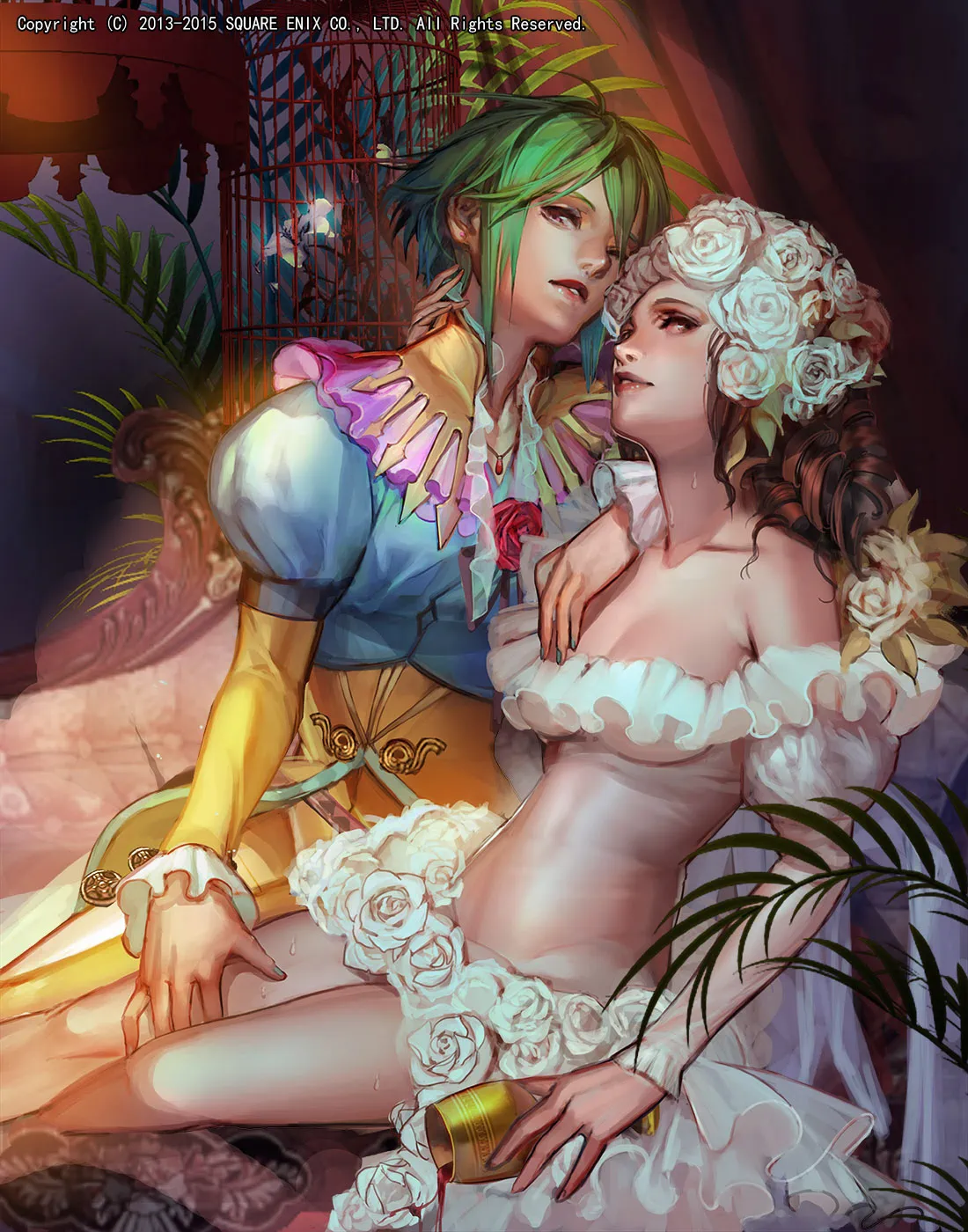
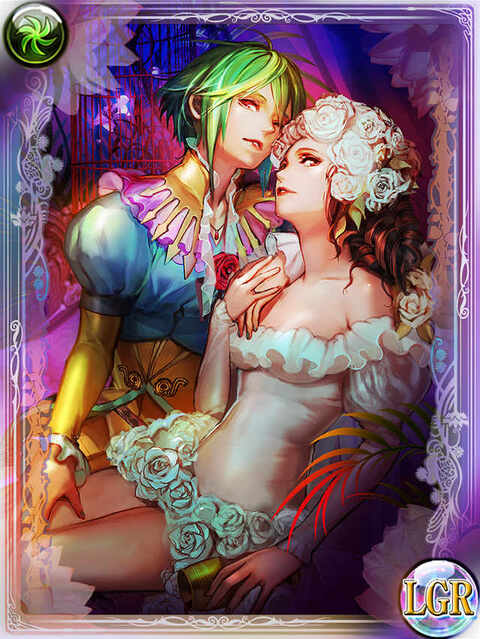 This exceedingly provocative illustration of Asellus and White Rose was not drawn for the SaGa Frontier game itself, but it is official artwork in later gatcha card games like Emperor's SaGa (2012). This is representative of Square-Enix's have-its-cake-and-eat-it-too queerbaiting attitude to the lesbian characters; at the same time as it denies or effaces the original game's more-than-subtextual relationship in strategy guides and public statements, it also sells artwork like the above, or adds sapphic fanservice to the remaster, or does stuff like this. For a variation in large size click here.
A new half
Asellus: Tell me one thing. Even with Orlouge's blood mixed in mine… I'm still a woman, amn't I? I haven't become some sort of… of a half-man, or something? Dr. Nusakan: Our blood is a different kind of substance than that of you humans. It transcends the merely material. Through his blood, you have inherited Orlouge's own fey power... which is to say, the power of a ladykiller.³
And who would not fear becoming like men, after a lifetime of experiencing how men treat women? The cliché of the “useless lesbians” exists because women are terrified of making the first move and becoming that guy. This is symbolic for Asellus because she's not just concerned about being half-man in the abstract, but half a particularly despicable man—Orlouge's “charm” can be wielded as, effectively, mind control, making his harem a form of serial rape.⁵ Even more to the point, Orlouge does not seem to desire Asellus as merely harem princess #100, but as a potential successor—a daughter, literal blood of his blood. (He does a terrible job of conveying this information.) Asellus, meanwhile, has lost her parents at an early age, and aches to find a place to belong, a good parental figure to symbolically adopt her—but that ain't it.
This is mostly background lore, their father/daughter dynamics only come out cursorily and at the very end. But what Orlouge as a father figure stands for is nothing less than patriarchy. As it has been often noted, patriarchy is not just the rule of men, it's the rule of fathers, and Orlouge is the embodiment of the Patriarch. We all fear reproducing the worst of our parents, and Asellus' horror is that of becoming the terrible, sleazy, abusive, absent dad that she's barely even met.
Could the “half-man” thing also imply that Asellus is struggling with gender dysphoria? Does her transformation into half-yōma, through a male yōma's blood, entails a degree of physical masculinisation? Is Orlouge's blood an injection of magic testosterone? It's tempting to read it this way, and there's definitely some undertones of transness—Asellus' body-horror obsession that “even like this I'm still a woman” is reminiscent of how many cis women feel when they're unwillingly masculinised, for example by menopause or PCOS. But much as I would love a trans story, I don't think that's a sustainable reading. Though Asellus becomes an exceedingly powerful swordswoman by the end game, at no point there's mention of her becoming more muscular, or getting a larger frame or male body scent or any other secondary sexual characteristics. (I am using all my willpower right now to not get started about my Asellus “half-yōma” headcanon, which starts with “f” and ends with “utanari”). If there's any unwitting masculinity in her, it's purely at gender level, it's the butchiness she's growing into—one can notice that when talking to male characters she speaks in a normal female register, but when talking to women she takes a gallant soft-butch tone that sounds straight out of Rose of Versailles or Princess Knight. But she never expresses discomfort with gendered changes in her body. No, every time gender terror comes into play, it's in the context of romantic/sexual desire; she has to reassure herself of being a woman whenever she finds herself attracted to women, or—even more horrifyingly—coping with her ability to make girls reciprocate, i.e. with the real possibility of satisfying that desire. In other words, Asellus is trapped in heteronormativity. In her mind, admitting to love a woman would mean she'd stop counting as one—she considers a lesbian couple and thinks, “but who's the man of the relationship? Oh no it me D: ” I believe this is what Zozma is talking about when he remarks she's still “binding herself down by trivial limitations”, when characterising her own love for White Rose as “sisterly friendship, because I'm still a woman”; her mistake is in the “because”.
Contrast that with the yōma noblemen Ildon and Rastaban, who are openly lovers; neither is particularly femme, nor believes himself to be half-woman because of gay attraction; nor does Gina question her own gender, or Asellus' gender, when she falls in love with the half-yōma; as soon as she realises Asellus is a woman, she promptly accepts the fact of being wlw. So Asellus' fear of being a half-man is homophobia, in the original sense of the term: the dread that, unbeknownst to yourself, you might be one of the queers, deep down. To bang on that note one more time, she's in denial. That’s why her quest isn't really about defeating the evil lord (which she's actively indifferent about, and only sets to after he threatens her girlfriend), but about coming to terms with her own nature. Asellus does not want to win a tournament or become the king or hero or anything; she wants emotional resolution to identity turmoil.
Ok, and eventually she also wants to save her girlfriend from the bad guys. Sometimes a videogame is just a videogame.
“I shall have 100… no, 200 Princesses!”
Asellus has three possible endings, with very interesting overtones. If you refrain from using the yōma's vampirism powers at all, remember to visit the tailor girl Gina (who has been left unmentioned for most of the plot) to discover that she's been taken by the court, and eventually go on a sidequest to save her, then Asellus will reject her yōma transformation; and, after defeating Orlouge, she'll find a way to return to human life, marrying and having children and grandchildren. Notice that this entails, in gameplay terms, refusing to use the very abilities that make Asellus unique as a protagonist; essentially she's forcing herself to constantly stay down to the level of a human, binding away her unique potential, until the “normalcy” sticks.
On the other extreme, if you embrace her yōma powers and also abandon the human girl to die, Asellus defeats Orlouge only to take his place as the new Queen of the Fae; she brings back Gina as an immortal, turning the tailor into her first Princess, and vows to outdo Orlouge by building a harem of over 200 courtesans. This is supposed to be the bad ending for some reason. (I kid; it's a bad ending because Queen Asellus is a bloodthirsty tyrant whose first act in power is feminicide; but oh!, her evil queen laugh is a delight…)
What is coded as “true ending”,⁴ as in many Japanese games, is the Middle Path: embrace the yōma powers, but also save Gina. In this case Asellus will become a wanderer with White Rose and a couple (male) allies from her yōma uprising. Gina lives a normal human life and marries and has children and grandchildren and grows older and older; an immortal Asellus visits her once a year, along with White Rose and the others. Old Gina explicitly describes these visits as meeting with the love of her life. Asellus feels envious of Gina's human life as a grandmother, but ponders that sadness with the thought that, now that White Rose is by her side for eternity, she'll never be alone again. I do not think it's a stretch for me to see envy in the other direction, too, in Gina’s reply that “you are lucky to have such good friends”.
In this way the fantasy drama of her mixed-yōma blood acts as an analogy for queerness; being human is consistently equated with heterosexual marriage and the cycle of life, reproduction, death; but the beautiful, artistic, and gender-bending yōma exist outside of this flow of time, and do not reproduce save by transformation of humans like Asellus and Gina, pulling them outside of the hetero cycle. In the timeless, decadent gothic world of the yōma, heteronormativity and monogamy rules do not apply. Yet gender and class dynamics still have hold, with Orlouge's harem being decidedly objectifying and cruel. Like many a budding butch player, Asellus find herself suddenly irresistible to the women she's now attracted to, only to recoil at the horror of having become man-like, of acting like the most toxic of fuckboys, King Orlouge; at that crossroads, she can lose herself by forgetting to care about Gina's feelings and reproduce patriarchy, or she can go back into the closet and reject the love she's found in White Rose; by choosing neither path, she becomes a new, better type of being, both empathetic and free.
 An aged Gina stares at a photo of eternally young Asellus surrounded by beautiful, luscious yōma women, wrinkled old fingers brushing the paper wistfully… (fanart: Tetora on Pixiv)
Notes
1: Mystics, Fae, or Yōma?
Let's write more words than anybody ever did on this translation!
Yōma isn't a fantasy word invented for this game, but a normal word in Japanese, and a loanword from Chinese. “Yō” 妖 is comparable to elf, fairy, trickster spirit; it has connotations of uncanny, alluring, illusory, dangerous, malicious. “Ma” 魔 is comparable to demon, devil (it actually traces back, through Buddhism, to the Indo-European root *mer, “death” that we see in “mortal”; it is present in the names of Morrigan and Māra, and it's also the “mare” in “nightmare”—originally not a female horse, but the evil spirit that causes sleep paralysis).
Put the two together, and you have something similar to the classic elves/fair folk—not the noble-minded Tolkien elves, but the seductive yet inhumanly cruel beings of folklore. I dislike the translation “Mystics”, but it's hard to think of something better than “the Fey” or “the Fair Folk” (my usual go-to for good translation suggestions, Kenkyūsha's Green Goddess, doesn't even list “yōma”). I imagine this must be why the “Mystic Sword” ability got renamed “Fae Blade” in the remaster—whoever translated that was probably provided with 妖魔の剣, yōma sword, in a spreadsheet without any context, and Faeblade would be a pretty good translation for that, except they still left the name of the species as “Mystics” and, even worse, the name of the other 2 abilities as “Mystic Gloves” and “Mystic Boots”.
There are many parallels between SaGa Frontier's yōma and the feyfolk: Like fairies, the yōma are ethereal, less tangible than humans. They both have an affinity with magic and monsters, and a court with rigid protocol. They both aren't so much evil (like demons) but rather have an alien, dangerous value system: Shōda has defined the Yōma values as 1. intimidation (inspiring fear), 2. charm (captivating with beauty), and 3. pride, all very fairy-coded. Like the Elf Court, Facinatoru is timeless, and Asellus lives through the classic faerie-tale experience of going back to the human realm only to find out that many years have passed for everyone else. The only wizard in the game who is able to use time magic, the unimaginatively named Time Lord, is a yōma wizard.
And, of course, the fair folk have long been connected to sexuality, seductiveness, sensual pleasures—most of all to queerness.
(The other clear influence on the yōma are Western vampires—coffins; blood; absorption; being gay and goth, etc.—but this isn't reflected in the name so it's out of scope for this discussion.)
We can get an idea of what the term “yōma” suggests to native speakers by comparing dictionaries:
- Kenkyūsha: “See yōkai.”
- Kokugo Daijiten: “Monster [bakemono]. Yōkai. Demon [mamono].”
- Kanjigen: “Uncanny demons who lead people astray”; “eerie devils who seduce/trick humans”.
- Kanwa Daijiten: ibid.
- Kōjien: “Henge [goblin/boogey/ghost]. Yōkai. Demon.”
- Shinmeikai 5ed: “Same as monster [bakemono], but said in a Chinese way.”
- NHK: “yó˺òmà”. Ah sorry this is the pronunciation dictionary.
We can see two trends here: 1) Broadly, all the terms for monsters and ghouls and goblins are kinda interchangeable, the same as in Western folklore; 2) more specifically, yōma are beings with the characteristics suggested by the yō and the ma: alluring but calamitous, eerily seductive but misleading into ruin.
I find it fascinating to consider the ancestral etymological connection between the name “yōma” and the “mare” spirits of “nightmare”, when the main attack spell of the yōma is the Phantasm Shot—or 幻夢の一撃 Mugen-no-Ichigeki, where “Mugen” is a compound of “dream” and “illusion”. Players will remember that an actual nightmare—rendered as a black horse “mare”—is one of the creatures that may be summoned by this spell. The dreamlikeness of Facinatoru is often literal; time passed differently for Asellus vs. her human family not because of a faerie distortion of time itself, but because she slept for 12 years; and Orlouge keeps most of his harem in deep sleep most of the time. Finally, this entire world exists as an elaboration of a vivid nightmare that Shōda Miwa had once (a nightmare about being ran over by horses). I'm sure these etymological connections aren't deliberate. They're there nonetheless.
Elves are wonderful. They provoke wonder. Elves are marvellous. They cause marvels. Elves are fantastic. They create fantasies. Elves are glamorous. They project glamour. Elves are enchanting. They weave enchantment. Elves are terrific. They beget terror. The thing about words is that meanings can twist just like a snake, and if you want to find snakes look for them behind words that have changed their meaning. No one ever said elves are nice. (Terry Pratchett)
2: Asellus is canonically not lesbian?
In addition to all the discussion about queerbaiting, the notion of “canonicity” is tricky to pin down in SaGa Frontier anyway. Statements such as “Asellus and White Rose are not an item because it was all influence from Orlouge's blood” are fan speculation based on Essence of SaGa Frontier; but Essence has a lot of tentative material that never made it into the game, such as the yōma and Asellus lusting uncontrollably for human blood, White Rose having assimilated to Blood Roses and literally growing roses out of her hair, Asellus sealing away her Mystic Sword with a talisman that burns her to the touch, Orlouge's Castle being full of low-class female maids servants, that kind of thing.
The best argument that can be made for Asellus being not really lesbian, based on text that actually ended up in the game, is that she wants to have a normal life as a human and be grandmother, and in her human ending she (at face value) seems happy like that, while in the half-yōma ending there's a bittersweetness over never having become a grandmother. But even players who think of the human ending as the “happy one” feel the tension that is to reject her entire yōma life (up to and including gameplay elements) and pretend it never happened. The intensity of her feelings for White Rose, and their reciprocation, is plainly textual, as is Gina's love for her; all of those are spelled out in the game we got. Moreover, the fact that evil Asellus keeps Gina and starts a harem can fairly be understood not as Orlouge's blood making her gay, but simply making her tendencies go out of control, removing all boundaries of ethics and empathy from her desires. We know precious little about human Asellus pre-transformation, but one thing we know is that she was so fascinated by a beautiful woman that she got herself ran over by a huge-ass horse carriage.
But the biggest problem with the often-quoted “not an item” statement is that it merely cites Essence of SaGa Frontier as a whole, without elaborating on which section and why. If we consider the entire book, Essence only makes Asellus *even gayer*. It says, for example, that her true ending never really made it into the game, but if so it would be something in between the “Half Mystic” and “Full Mystic” endings, so even more overt than the half-yōma ending we got. Fuse's Crazy Journal openly portray Asellus and White Rose as girlfriends, unambiguously—like Zozma, Fuse spells it out—and it ends with something similar to this proposed happy ending, and just as gay; we got a version of that in the remaster, as Fuse's Case Files (see Note #5 below for “true ending” discussion).
3: The power of a ladykiller:
Onna-goroshi. Felicitously, the ambiguity of the term translates directly to English; in both languages “ladykiller” is an expression for “womaniser” that keeps sinister overtones, Orlouge being both a seducer and a murderer of women. Within the context of the conversation, it's clear that Dr. Rastaban means the “seductive” connotation (they're definitely not discussing Asellus killing women, save perhaps with yearning…).
I'm unsure how to translate his concluding remark afterwards: either “mere human girls wouldn't stand a chance”, i.e. informing Asellus that her charm is now irresistible—no you're not half-male for having his blood, you're something more compelling than mere men; or it can also be translated as “a mere human girl [=Asellus] wouldn't stand a chance [against yōma blood]“, as in the humanity/femininity/heterosexuality in her red blood was overpowered by Orlouge's blue transfusion. I find the latter interpretation at least plausible, except that Asellus replies with “no! I don't want to have such a power!” and Dr. Nusakan remarks dismissively “then simply refrain from using it/suppress it yourself”. So the first meaning must be the intended one, and Dr. Nusakan is confirming to Asellus that yuri is on the menu, so to speak.
4: Orlouge's charm as brainwashing:
A small mistranslation illustrates this point. When Asellus and White Rose first battle the Amazon warrior of Orlouge's harem, Princess Golden Lion, she interrupts the combat after trading a few blows, saying that she has come to understand the depth of White Rose's feelings for Asellus (and also remarks obliquely that she herself once felt that way (lesbian Golden Lion confirmed, girls)). They then express concern that Golden Lion is bound to be punished for disobeying Orlouge's orders to capture the fugitives. In the English release, Golden Lion says that she doesn't mind taking punishment if it's for your sake (=I'll do this for you, Asellus, or possibly you=White Rose), implying that she's so moved by their love that she's willing to face the dread lord. But in the original, Golden Lion says rather that she will be happy to receive punishment if it comes from His Majesty—using Japanese grammar that not only shows complete submission to Orlouge but also treats the punishment as a gift; “coming from His hand, it will be an honour.” The implication is that even a strong and proud woman like Golden Lion is unable to fully break out of Orlouge's brainwashing—even while disobeying him, her devotion stays unshakeable.
“A wonderful woman like her is into this asshole dude? It definitely must be brainwashing” is kind of a recurring trope in lesbian fiction; I just read Gentlest of Wild Things by Sarah Underwood where that's a core premise.
I'm calling this a “mistranslation” because I'm guessing it wasn't a deliberate rewrite, but I actually like the English version better. From the background lore in Essence of SaGa Frontier, we know that Golden Lion secretly sympathises with Asellus' political uprising, not for lesbian reasons but because she's a feminist (outside of Orlouge's brainwashing), and hopes that conditions for women yōma would be better under Asellus. She nonetheless would still have sided with Orlouge in the end, presumably due to the power of fascination. This isn't clearly signalled in the game, so making Golden Lion willing to take punishment for Asellus' sake acts as a nod to this side of her character, in the version of the story we got.
5: Asellus' True Ending:
“Essence of SaGa Frontier” says that Asellus doesn't have a true ending per se, because she was supposed to learn more about herself in scrapped sidequests. In the remaster, the sidequests were restored, but she doesn’t actually learn much we didn't already know, and no new endings were added. Apparently the canon ending would be “something in between the Full Mystic and Half-Mystic endings”.
Fuse's Crazy Journal, essentially developer fanfic given in Essence, is the prototype of the Case Files added to the Remaster, which can fairly considered to be her best ending. In both the Journal and the Files, Asellus' insurrection is aided by the IRPO, which arrests Orlouge for kidnapping human girls and seals him away in Despair—along with his powers. Asellus embraces her status as half-yōma, and (differently from the half-yōma ending) also accepts her position as the Lord of Facinatoru, with Rastaban still alive and among her allies. Unlike the Full Yōma ending, she does not become a tyrant nor abandons White Rose, but instead maintains a loving relationship with her, which means that their love does not depend on the Charm Lord's supernatural fascination power. And in the Crazy Journal version, half-yōma Queen Asellus is also seen comedically excited at inheriting Orlouge's harem (a fact that causes a fit of jealousy on White Rose).
As for the argument of Shōda's authorial intention, as we have noted, all that the writer makes clear is that she wants every ending to be plausible and every player interpretation to be valid—that is, she does not want us to decide by authorial intention. This idea of multiple endings being all “canon” would itself become a canon of sorts in the “aftergames”, the various SaGa franchise cash-in crossover titles including Emperor's SaGa, Imperial SaGa and Romancing Saga Re;univerSe, which turned the franchise into a multiverse kind of thing, with various versions of the characters coexisting in alternate dimensions. I have not played these games and I do not know what, if anything, they imply for this analysis, but it's clear to me that the Fuse-style “golden ending”, where Asellus both ends up as the Lord of Yōma and keeps White Rose as a lover, is treated by the fandom as the comfort ending and the happy resolution to the various tragedies of the original three.
Taking a step back from trying to make sense out of a lore that's both sparse and conflicting, we can simply ask ourselves what kind of videogame experience we are having; and when you're playing women talking about their undying love for other women, or getting depressed to the point of catatonia for losing a girlfriend, or setting out to build harems of concubines, or White Rose (in Re;) giggling about the flushed reactions she'll get from her girl by wearing a sensual dress, et cetera—come on, make whatever excuses you want, we be playing yuri games.
 Asellus: I shall have 100… no, 200 Princesses! And I'll put all of them in maid dresses, too!! [untranslatable gooner brainrot] lolol
Rastaban: Lady Asellus! That is, uh, not really the same as Lord Orlouge I guess but still super sleazy!!
Asellus: Silence, Rastaban! I shall surpass that man in every way!
Asellus: In every possible… hm?
Asellus: Wha—I only got two horns?! Even though that man had THREE?? Hey, look at this—a MEASLY two horns!! That's not what we agreed! I demand at LEAST six horns!!!
Rastaban [crying melodramatically]: Lady Asellus… those weren't horns, 'twas but his crown…
(Evil Queen Asellus fan comic by Kouya on Pixiv)
Asellus: I shall have 100… no, 200 Princesses! And I'll put all of them in maid dresses, too!! [untranslatable gooner brainrot] lolol
Rastaban: Lady Asellus! That is, uh, not really the same as Lord Orlouge I guess but still super sleazy!!
Asellus: Silence, Rastaban! I shall surpass that man in every way!
Asellus: In every possible… hm?
Asellus: Wha—I only got two horns?! Even though that man had THREE?? Hey, look at this—a MEASLY two horns!! That's not what we agreed! I demand at LEAST six horns!!!
Rastaban [crying melodramatically]: Lady Asellus… those weren't horns, 'twas but his crown…
(Evil Queen Asellus fan comic by Kouya on Pixiv)
 Thirty years later and only now I found out that “Asellus” is not a made-up name, it's the name of a couple stars in Cancer. In fact, most of the yōma are named after stars; “Rastaban” is β Draconis, Zozma is δ Leonis, etc. Asellus is also the genus of small crustaceans depicted above. And the word means “small ass” which yes, I do find hilarious. (It's “small ass” as in “little donkey”, but my 5th-grade sense of humour is timeless and immortal.)
If you're a SaGa Frontier fan, check out also: Questions I still have about Asellus deep lore