How tf do people learn how to music?
I don't really understand how to learn music. Or arts in general. Because I am a linguistics researcher I know how people learn languages (you don't really “learn” them), and I understand how people learn things like math or sociology, which is completely unlike language. But music is a bit like language and a bit like math. I'm having a lot of fun with musicology (the equivalent of linguistics, as opposed to language learning); but just like studying grammar is an entirely different skill and wholly unrelated to the process of becoming fluent in a language, or just like researching sports science is a different skillset and unrelated to becoming good at playing a sport, so also analysing the structure of music is an entirely different skill than actually being able to produce it. I understand how the former is done, but the latter? It baffles me.
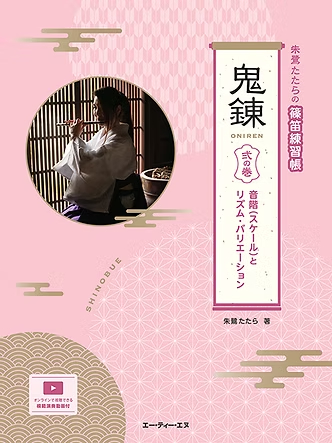 Shinobue books will often have titles like “The joy of shinobue” or “Gentle shinobue for everybody”. Then there's the reverse psychology way of appealing to customers: Toki Tatara's Oni-ren (“demon training”) drills carry the implication that if you survive these intense exercises from hell, your skill level will go up. But does either rationale necessarily follow?
Language is a special thing because it's an instinct, like walking. A baby exposed to language will acquire it without thinking. Contrary to popular belief, adults also acquire language not through analysis or drills, but intuitively through use; essentially, your provide material to trigger and feed the instinct, then you get out of the way, and let your subsconscious do the work. Formal exercises like grammar drills, duolingo etc. are a red herring and a waste of time.
The worst part of the pointless exercises is the “fullmetal alchemist law of equivalence fallacy”: the idea that if you pay a high price, that must mean you're getting a quality thing out of it. No, sometimes you're just getting scammed. Boring grammar drills feel like you must be making progress, because they’re boring. You did the pain, so you should get the gain, right? Wrong, language acquisition happens pretty painlessly actually. It feels like something that goes in the background when you're focused on something else. You're trying to understand the uncaptioned new season of your favourite series to see what happens, not trying to “learn English”. When you realise it, English has happened to you.
This is very unlike learning (say) to embroider, or to solve calculus problems. A baby exposed to embroidery or calculus will never get anywhere. Not even writing works like language. Most skills have to be studied, learned, not simply acquired.
But music is complex. A baby exposed to music won't pick up an instrument and produce music-passing noises without instruction (I think ??). But they will definitely dance and sing, and intuitively be able to tell what type of music is meant to be sad or upbeat or relaxing. Music seems to sit halfway between instinct and artifice.
Some approaches to music are a bit like language acquisition, or like embroidery. I'm thinking of the type of folk music environment where people learn mostly by being given an instrument and a handful of simple instructions, and then get basically thrown in the middle of a jam, sink-or-swim, with no theories or formal drills of any kind. This type of music learning focuses on the ear, on intuition and musical sensibility; which feels quite sensible to me since music is a sound and feeling thing, not a sight and think thing. Then at some point your music group is trying out a different raga and that's when you learn how to play in the other raga, or even what is a raga.
Then there's the traditionalist academic conservaitoire type education, of course. Music theory, sight reading, scales, chords, drills, études. A teacher from this tradition will tell you sternly, don't just go and try to play popular songs on a random instrument, you'll suck. Get a firm grasp of the fundamentals, then you can play any song you want from sheet music. Delay your enjoyment for (a year/ five / ten years), do the work first. This is a bit like the art teacher who says: don't try to draw animes and cartoons, you have to be able to draw realistically from still life before you can play with abstracting features into cartoons. If you go straight to cartoons you'll suck. Now here's five workbook recommendations to work on your anatomy and perspective…
Approach the one, and approach the two. If you want to learn how to make music, which one? If you mix them, then how much of which, when, in what context?
It's easy to dunk on the academic approach but when you've been drawing animes for a while and every single time your faces end up deformed in a way you hate, you start kinda yearning for some repetitive anatomy workbook that promises you it will finally make your faces look like faces. Maybe if I do these scales every day for six months I'll finally be able to jam in a way that will feel like music, rather than random noises that don't fit with the track?? It's easy to think that music should be purely aural and intuitive, and I'm sure this is true at some essential level, but for very complex music like Bach I feel like I can appreciate it much better after learning theoretical concepts—and while watching a graphical visualisation of the counterpoints.
And then there's some even more mysterious effect where binging too much on music theory for a few weeks has increased my intuitive sensitivity to music. It's not that I now go, “oh indeed here the composer has subverted the progression from a subdominant chord to a counter supradominant augmented inverted borrow of the Locrian mode, a bold move 🧐”. No, I still can't tell what key a pop song is in, let alone whatever the heck is happening with the chords and modes and all that. But without me being able to analyse it in any way, Terra's theme from Final Fantasy VI now has made me cry. Multiple times. I first played Final Fantasy VI decades ago, Terra's Theme is great but it never made me cry before. I have no idea how or why this happens. Maybe it's just being in increased contact with music at all that expands one's sensibility, not the theory itself. But it doesn't feel that way; it feels like learning abstract concepts with the rational mind has primed the intuitive mind about what to pay attention to, like my subconscious was listening to the 8-Bit Theory videos along with me. That may be purely imagination on my part, of course.
Then again, the notion of “hell-training” has serious issues with selection bias and assuming causation. “My teacher yelled at me constantly while I did two hours of solfège chords on piano for two years straight, and I became a good pianist. So that's how people become good pianists”. This ignores all the other students who quit along the way, and fails to consider if there's any other ways that people demonstrably become equally good pianists, without the yelling, maybe without even the scale drills. Maybe if you do 2 hours of anything on the piano every day you become a good pianist? Or maybe not literally anything, but maybe less boring things would also do?
Which I guess is the basic idea of music pedagogy approach the 3: modern iconoclastic methods. Methods that believe the academic approach kills the music, starves it from all creativity and originality and joy, and makes traumatic bugbears of what should (in a moral sense) be a form of play and fun bonding. The iconoclasts often will chase spontaneity and joy first, encouraging dancing and whole-body involvement, and offbeat stuff that can border on corporate team building exercises. But hey, who knows. Maybe juggling balls before holding onto my flute will help me relax and make my kan register less strained?? I feel about musical education the same way I feel about my sex life: dunno fam no idea how any of this works, I'm open to try anything as long as that mysterious chemistry hits.
Unlike the case with language acquisition I don't think the repetitive drills are best thrown away in the compost piles of history. My daughter is an artist I admire, and her sketchbooks are filled with, say, one entire notebook only of hands in various positions, another just with sketches of shoes, or houses, etc. But as a mother I also know better than anyone that my daughter has been drawing for fun and joy since she was, like, 5; she doesn't draw as a duty, she draws as a distraction, as procrastination, which is the same sweet spot where language acquisition happens. I would escape math class by secretly reading books under my table; my daughter would draw. I became an academic, and she an artist. When I tried to learn to draw, I perceived it as a highly frustrating activity; nothing looked like the way I wanted, and the process to improve it felt like an impossible mountain to climb. For my daughter, drawing can get frustrating at times, but overall it's what she does to relax when something else is frustrating her. Climbing the mountain is a pleasant hiking stroll to air her head.
This is very much comparable to how language acquisition happens best through binge-worthy material: hours of activity is the king, whatever you can find that keeps you engaged for a huge fuckton of hours is what will get you there. Of course, the real problem is how to find input material that is 1) compelling to you in particular while being 2) sufficiently intelligible that you can engage with it at your level. Transpose it to music (pun intended): I don't think one can become an artist or musician without nurturing that sense of enjoyment of the process itself. Any music method that keeps you engaging with your instrument in any way gets a huge advantage against the competition, in my book. But of course if you keep doing the same thing forever you won't advance. Question is what kind of musical activities can be compelling for you in particular, while still developing skills upwards? What activities are engaging and beneficial? Sometimes it feels like boring works best—it's less boring to play a piece at speed and wholesale, but when I'm unable to do that despite repeated attempts, then working on it bar by bar in slow motion seems to get me there. But if that's all that I did all the time, I'd burn out fast.
I worry about the musical intuition, the sensibility. Some people believe sight reading and playing by ear are mutually exclusive, learning to read scores would ruin your aural sense of musicality. I think it must be more like my daughter, who seems to build her artistic sensibility both with the “folk” method (intuitively by imitation and exposure—she used to spend days binging on art tutorials on youtube, drawing along coaches) while also using the “academic” method (by reading on colour theory or doing perspective work, for example). I don't see how learning one thing would ruin the other, though of course some people are more naturally inclined towards one thing or the other. But one can probably mix and match, try one way when the other isn't working; I think nothing stops you from learning chord progressions academically but solos intuitively, for example.
I guess some sort of balance is warranted, but I don't want to just say: “they all have their place”, that feels like too easy a solution, too facile. There's no cosmic balance reason why every method should necessarily be as valuable or effective as the others. Who knows? Maybe it is just like language acquisition and all those drills aren't doing anything, and you could just have been doing fun intuitive explorations all along and it would work even better at training musicians. The conservatoire people know a lot more about music than I ever will, maybe they're right and and you can only really get fluent in an instrument if you do solfège over scales every day for ten years.
Purely through my own bias, I tend to believe the folk method must be the best supported; clearly the academic approach works for training musicians in the European classical tradition of the 18-19c., but that's an incredibly narrow definition of music, while folk methods have been used for everything from indigenous sacred music to Bulgarian choirs to Afro-American rap to Brazilian repente to Indonesian gamelan, and much else besides. The problem is my trichotomy comes apart at the seams when you look at it more closely. It's not like older traditions don't have drills or hell-training methods, for example, even if less intellectualised than orchestral conservatoire principles.
Maybe the key is to go to the repetitive exercises very deliberately, with a specific goal in mind. You have to treat boredom as costly, and be thoughtful about how to spend your daily bore budget. Doing drills because they're hell-drills is a mistake, and extrinsic motivation (like grades or diplomas or a sense of clout) is downright counterproductive. But they become intrinsically motivated when you're trying to achieve a piece, and there's a weakness you understand and want to address. Like, my daughter filled endless pages with shoes because she was already drawing scenes that she wanted, except she kept being frustrated with how the characters' shoes looked like. I'm very glad to have found Toki Tatara's drills on dynamics right now because it's super clear to me how much her rendition of Sakura benefits from that type of dynamic phrasing, and I envy that, I want to steal her technique; I want to be able to do dynamics like her in my own Sakura. And it's very transparent for me that if I can apply that crescendo-decrescendo shape to repetitive long tones, that will make me able to do the same to the crunchy minor seconds of Sakura. This feels very different than unthinkingly doing scales every morning in the hopes that it will make me a good musician somehow.
Crucial to this is that you have to do the exercises with the deliberate intent of actually getting good at the thing you're exercising. If you're not improving, the exercise isn't working and should be reconsidered. This sounds silly to even say out loud, but the psychology of training is kinda fucked up, it's actually deceptively easy to fall into a “duolingo” mindset, a Protestant work ethic mindset, where the suffering is the point, basically in a moral sense. You define yourself as somebody who is “bad at anatomy” or “bad at timbre” and you're not really taking in consideration what life could be if a few weeks from now you become competent at anatomy or timbre. Your definition of “myself” would change, you won't be able to hide behind “ugh I'm so bad at this”... anymore, and that's scary. But that scary place is where you want to go. It's important to not take the eye from the ball, to not let suffering become, perversely, a kind of end in itself, a part of your personality, a brag (“yeah I've been doing 2 hours of scales every morning for a year, it's hell… [smugly]“).
Thinking about it as martial arts training: the point of shadowboxing and bagwork is to punch the other girl in the face. You have to want to punch the other girl in the face. If you're just standing there and punching randomly at sparring you're doing the other girl a disservice, too, you're teaching her bad habits, neither of you is learning boxing. You have to be actually trying to win the match. If you can't evoke that crave, all the shadowboxing in the world will be just a cardio routine. If you're not yearning to play a piece with good tone, all the tone exercises in the world won't make good tone happen.
The danger of the academic method is pedestalising suffering for its own sake. By the same token, the danger of the joy-based modern approaches is iconoclasm for its own sake. Not every icon is as clasm-worthy as the others. Iconoclasm is great when it improves something, otherwise you're just being a contrarian for the sake of your self-image as a contrarian. Sometimes traditional methods are kept around just for the sake of tradition even when they're bad; but sometimes traditional stuff gets abandoned just because it's old, when it's actually well-motivated. And the danger of the folk intuitive approach is plateaus and sameness, I suppose. In Japanese folk for example there's a tendency where “living treasures” (more or less “geniuses”) emerge every so often, get treated basically as gods (sometimes literally), and everybody else just tries to imitate the geniuses. Maybe one can use one of the 3 practice approaches to escape the limitations of the others when they become a drag, like, eyes on the ball: do whatever feels more appealing to you as long as it keeps being engaging, but if you start feeling like you're not improving, try one of the other approaches; just make sure you're actually trying to get somewhere. “Drill and hope” probably doesn't do much.