Kendō: The hard questions
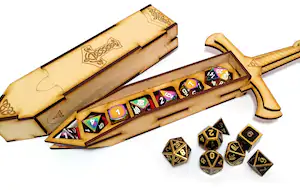 The thing hidden in the sword.
Is it, like, samurai zen meditation or something?
Last kendō class was newbie day and I got to be the sempai for a while (we split in little groups) which was very rewarding for me as I'm like, a frustrated IT drone who wanted to be a teacher. I just love teaching in general.
Then after class one of the newbies was asking the actual teacher about the spiritual meaning of kendō and such. Which is a bit of a faux pas, see, we don't talk about stuff like that. It sounds incredibly corny to even try to say it but all that stuff about “the dao that can be spoken of” yadda yadda is actually too real, like, when you start talking about “the state of no mind” and “sen-sen-no-sen” and whatnot, you quickly find yourself larping a fantasy of a zen monk. And while I am a big proponent of larping in general, there's a point to distinguishing when roleplay is roleplay. So kendō people only ever talk about like, the angle of the knees and how to push momentum into a thrust. They say at the outset that “the purpose of kendō is to train the mind” and leave it at that; the rest becomes self-evident by doing, if you do it enough.
But this was clearly like, a spirituality-minded guy and he's a beginner, it's the privilege of beginners to break the taboos and ask uncomfortable questions. It's a reasonable question if you're considering whether to get into the discipline or not, and your interests are primarily spiritual. So the teacher was being like, “people usually can't explain why they do kendō. It's not fun.¹ It's no good for self-defence.² 'I do it because it's a thing I do.' But when you keep at it, there's… a secret.” Which is his way of saying what I described as, there's some hidden thing inside the sword; it calls to us.
1: [citation needed] 2: [citation needed]
But then the newbie asked point blank: And what's it? what's the secret?
Pressed to put in words the unwordable, the teacher struggled for a long while, then said: “The… thing that you think is 'you' is not really in charge.”
Which put me to thinking, even now. I guess it's as good a way to say it as it can be, though I still feel like, talking about it is a bit of a red herring. You can be intrigued by this idea and discuss the idea and kinda bat for the idea, make it a part of the “you”, like pinning political badges to one's jacket. But to be in the space without “ideas” and “yous” is a different kind of thing altogether, and talking about the idea too much stops you from getting that. Still, the questions have to be answered.
Teacher often compares kendō to tennis. It's a good way to demistify it. It's a sport. It's played 1-on-1. You hold a whacking tool. You try to score more points than the other person. You spend years shaping and optimising your minute body movements and fastest reflexes to perfectly fit the needs of the scoring, with split-second reactions.
The only difference is that instead of trying to whack a ball you whack one another's heads. You're the ball. It's full-contact tennis.
(And yes there is all this spiritual stuff and so on but I'm pretty sure that a high-level tennis player will reach similar states of flow and whatnot.)
I think that's a good metaphor, but to elaborate on that evaluation of kendō as “not fun”, I would like to compare it with ballet. I mean I never did ballet, but I know people who did. I'm told the training is absolutely thankless and gruelling; months upon months, years of doing repetitive exercises and painful foot blisters and potential joint injury, before you can do much of anything. Kendō is like that, very steep learning curve. The way of handling the body is not natural, and nothing like most martial arts either.¹ You joined it trying to be a badass swordslinger, and then you have to spend entire classes inching around the floor like an awkward penguin, then you forget not to put strength in your right hand, which everyone can tell right away and call you out on it, so you fix your grip, but now you lost unity with the back foot. Repeat for seemingly forever.
But if you put up with it up to the point where you can actually wear the armour and do matches? If you stay with it up to the point where there's this strange telepathy happening, where you can tell what the other person is feeling and doing despite not seeing their face or anything, from their sword alone? Oh yes, now we can dance.
I have a lot of fun at the matches! Kinda like the best 3D fighting game I ever played. You still have to keep doing a lot of unfun exercises and stuff—way more repetitive exercises than duels—but I think that's true for any sport. The gravitas, the high-impact, the like, stillness stillness BAM “doooo!“—it's definitely a thrill, incomparably more interesting to me than the way Olympic fencing chose to gamify swords.
Still, I don't think anybody does it for the fun, not alone. If you want to have fun, there's much better ways to do that. A night out at the lesbian bar, for example. If you want to learn self-defence, too, you can spend the same amount of effort learning guns and muay thai and trauma aid, and you'd be much better off. Or even if you just want to feel like a swordswoman, I mean you can go to a ren faire and hold a real metal sword and wear actual armour at HEMA, and all of those things are great I'm not dissing them. But kendō lives in this awkward space: a sport that seems to resent being competitive and refuses to be part of Olympics or similar events, a fencing where you only ever hold bamboo and wooden sticks, a martial art that's so abstracted as to forgo any claims of applicability, a “method of disciplining the heart” that never discusses spirituality. It is, I think, a thing of compromises.
At the core of kendō is the idea that sparring is important, that whatever compromises it requires, we can't rely on kata alone; martial arts are dead if you don't have opponents actively trying to win against you, coming at you at full speed. (Even a boxer's hand moves significantly faster than the brain can react; a sword multiples this speed several times due to the lever principle; if you never experience that, you don't understand how fighting works, one cannot rely on “if they do this I do that”.) Sparring is important, but the winning is not. Or, well, the winning is important, but also it's not. it's hard to explain. If you make the sport be about winning, then it becomes a “mere sport” in the depreciative sense; it gets sidetracked by money and ego and sponsorships. You have to try to win, to want that, whole-heartedly, and at the same time you have to not try to win, and in fact not to try anything at all.
1) Body movement in kendō has something more in common with roller skating or, even more closely, skiing, I think. I expect people with that background will have an advantage in learning the footwork. People from karate or boxing struggle to unlearn drawing strength from hip torque, and how to keep their dang feet pointing forwards (but they have an advantage in the sense of spacing and timing).