Mountain cherries or Somei-Yoshino: Microtonality in the shinobue flute
The shinobue is a very simple instrument used for folk music, not meant as something transcendent or intellectual like the shakuhachi or ryūteki. The other day I got the 5€ booklet Yamada Kaishi and Fukuhara Kan, distributed by Suzuki along with plastic instruments, often intended for children.
I was surprised to find, already at this level, a discussion of how the cross-fingering known as 0—nominally the same as a flattened 7—is actually not exactly the same pitch as 7♭, and that the difference should be used mindfully for emotional expression. Moreover the nuances are specifically noted as relevant for what I've been obsessing with for over a year, which is to play a good rendition of Sakura, Sakura in particular.
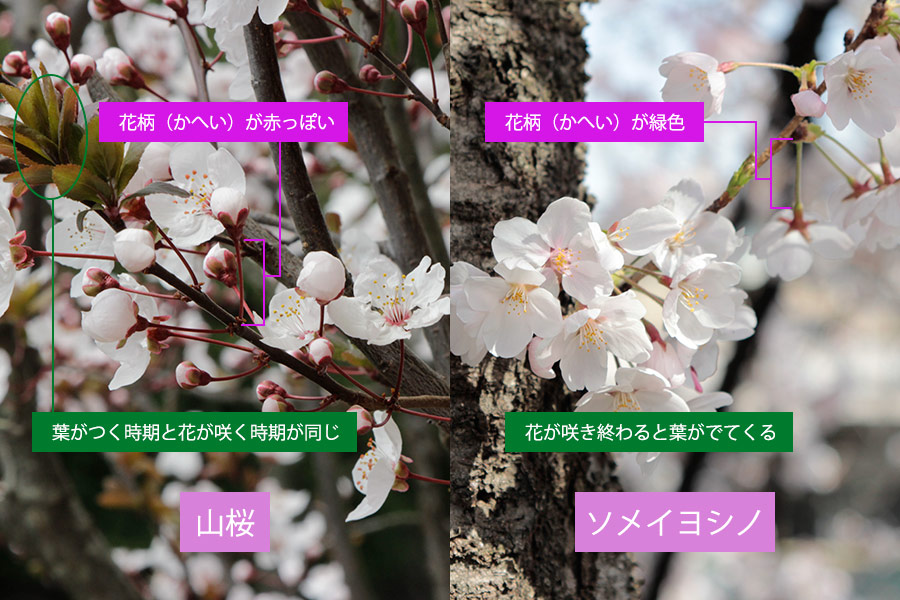 Wild mountain cherries (left) and the elegant Somei-Yoshino cultivar (right). Image from Siezarrei's blog.
In the shakuhachi world, meri (noted as メ or ×) is the gesture of tilting the head to shade the blowing hole and flatten the note. But a note can also be flattened in the usual flute way, by half-fingering the note’s tone hole, and this can also be called, broadly, meri; the word is used much like “flat”. In the shinobue world, head-meri isn't common because the notes get too breathy or disappear, and meri usually refers to half-fingerings. Due to mechanics and anatomy, the way you shade each hole is different; usually much more of the hole is covered than what the name “half-fingering” may suggest.
In the base registers, higher notes are created just by lifting one more finger, effectively shortening the length of the tube; so that fingering 1, 2, 3… is when you open one, two, three… holes, which on a size 8 (8-hon chōshi) will do a C, D, E… Therefore for fingering 6 (A) you close only one hole, and for 7 (B) no holes at all. And for 7× (7-meri) you half-close the topmost hole.
Now fingering 0 is a strange cross-fingering. You close all holes but 6, the next-to-last one (●○●●●●●). This produces something nominally in the same pitch as 7×, but there's nuances. Even the basic booklet remarks that 0 tends to be sharper than 7×, though still flatter than 7. We could maybe distinguish those as A♯ and B♭ and clarify there's a microtonal difference between them. But it gets deeper:
7× and 3× are actually played lower than 7♭/3♭ to create a tense, beautifully delicate nuance of expression [不安定な美しい繊細な表現].
Meanwhile 0 is considered to not have the same anxiety/instability/tension (不安). This is interesting because you can control the pitch to an extent by covering the hole more or less with your finger—in fact I find it easier to play a 7× tuned to A♯/B♭ than to do the same with 0, so I was surprised to learn 0 is supposed to be the sharper one—but no, it's 7× and 3× that are used for extra-deep microtonal nuance, which means they're played lower than a flat on purpose.
(With 3 this is easy because I find it hard to play a regular E in tune in my shino anyway, my flute in 3 seems to be naturally a bit flatter than the nominal chromatic, and 3× follows suit for E♭).
Using microtonal notation rather imprecisely, we could say that the shinobue nuanced notes are (again, on size 8):
- 3× : E♭♭~E♭
- 0: A♯
- 7×: B♭♭~B♭
Where B♭ and A♯ may be more or less the same note, potentially with a difference in colour, but B♭ often hits lower, and B♭♭ lower still.
Then there are even more alternative fingerings for a note “between 6 and 7”. Treat this tentatively since it’s subjected to my amateur technique as well as varying with the instrument (I’m told). But on my Rakusui sudake 8-hon I’m getting, in the low register:
- ●○●●●●●: Bb -40c
- ○●●●●○○: Bb +25c
- ○●●●●●●: maybe B-10c (subtle enough that it gets confused with natural breath angle variations from tapping the fingers.)
The first example is the widespread “0” fingering. Second one is given as an alternative fingering (替え指) for 0 by Tomomi Yoshino, who gives the caveat that it doesn’t work well on every instrument. The third is noted as ⑦ (or really as circled-七) in this chart by Sugiura Neo. I got the results in cents in the low register (ryō), by finding an angle and air speed that plays a 6/7 in tune with equal-temperament A and B, then doing my best to change the fingerings without altering the position or angle or breath speed or anything. Since 0 is supposed to be sharper than 7×, I don't know if I'm doing something wrong that mine is so flat.
Unlike the finger-shadowing gradations and the choice of 0 vs. 7×, I don't think nuances of the other alternate fingerings are used in the traditional shinobue repertoire (in so far as that's a thing, given that folk shinobue weren't even tuned to a reference scale to begin with). But that may be just ignorance on my part.
And then back in the Yamada/Fukuhara booklet, they give an example of how to use these gradations with nothing else than Sakura, Sakura:
In Sakura, try to deliberately establish a different atmosphere by varying the pitch of the 7×. I believe with a higher tone you make it like a Somei-Yoshino, while a lowered position gives you wild mountain blossoms.
This is delightful.
The version of Sakura I've been doing starts on kan register at like A-A-B…, which on a C-keyed instrument requires no half-fingerings. But then you stay very high on the upper registers, so it requires super good tone control to hit those extra-high-pitched notes without sounding too loud and strident (in the shinobue the high notes have to be loud and strident, but there's a degree of dynamic control with practice). This is the reason why I've been struggling so much with trying to get a pleasant tone and timbre out of the highest notes.
But to do that microtonal modulation effect, we need the notes to fall to either B♭ (7×) or E♭ (3×). The version of Sakura in the book is transposed to start on D, like, D-D-E, D-E-F-E-D… which will fall down into the ryō register on either B♭ or B♭♭ or A♯ , according to how you want to perform it (the spicy note will hit on the “wa” of yayoi-no-so-ra-a-wa…).
I'm thinking I can perform by doing both—first the low-register version, then the high-pitched version—which amounts to a change of key, or more precisely of tetrachord nuclei. The higher Sakura I've been trying is on tetrachord E·A, but the version in the book is A·D, meaning the miyako-bushi colour note transposes from F to precisely that spicy A♯/B♭. And happily, the fact that these tetrachords share a nucleus gives me a jumping point to transition (the melody of the one version ends on the start of the other).