11 things that were not obvious to me when I took up the Japanese bamboo flute
No not the shakuhachi, the other Japanese bamboo flute. The shinobue. The easy one they give to children. It's already plenty hard for me =)
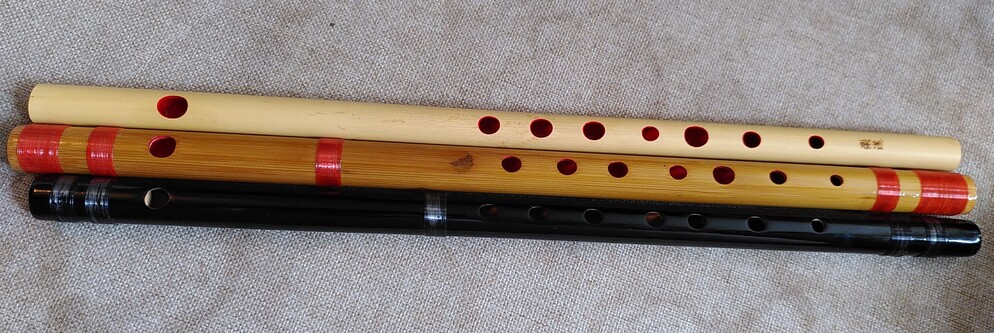 One flute I use every day, and two others I never use. Mistakes were made.
Updates to this post:
- 2026-04-22: Added footnote with analysis of the cheap “Yamamoto” shinobue.
1. Each note is blown in a different way
I knew that you need to blow “sharper” to reach higher registers, but not that this isn't a binary thing—even in the same register, the further down the pipe you go, the “wider” you need to blow to make the notes sound. This is done with minute adjustments of lips or jaw or flute that are very hard to convey in words, and must be found experimentally then drilled to muscle memory. It takes time.
(N.b. it can also be that you lose the tone when going down because some hole isn't fully covered by its finger. It's more likely than you think.)
The visualisation that helped me the most is imagining puffing on your hands to warm your fingers, vs. blowing to cool down a burn. You have to control the spectrum of blowing “warm” vs. “cold”. A good exercise is to actually blow onto your palm—do your flute-playing embouchure and, taking care to stay relaxed and fully without tension or compression in your lips: how far can you blow onto your palm and still feel air? Can you direct the air jet up and down to your wrists? Can you make it “warmer” and still reach far?
2. Quality of tone
It feels really nice when you finally become able to make the damn thing make a sound, and again when you finally figure out the trick to kan-on. So you hold onto whatever you did for dear life, terrified that the note is going to disappear. Sadly, you probably sound like ass doing that. We found a lip position that kinda more or less works but is poorly focused so we optimise by blowing too much air, which makes it breathy and full of those little whistles, so we get tense with frustration, which furthers degrades the jet quality, etc.
One reason is going off-tune. Small details of lip and head and flute position change the pitch a bit; it's common to unintentionally go a semitone too flat all over, or else to go flatter on low notes and sharper on high notes. A very helpful exercise is to play the scale to a pitch tracker (I use VocalPitchMonitor on Android, but anything with a line visualisation of the pitch will work).
But it's not just the pitch, it's also the timbre. How clean the note sounds; how full, how pleasant to the ear. There's a distance between making the notes sound, and making the notes sound good . You have to listen to yourself, including by recording yourself, and set it as a goal to make it sound as good as the skilled shinobue players you see on videos. (Peeking on Audacity, I realised a “brassy, harsh” timbre translates to too much energy at certain upper harmonics, like you're playing ryō but there's energy on the 2nd harmonic (used for kan) nonetheless).
Learning to play the flute has made me incredibly jealous of keyboard players who can just press a button and get any note at any time.¹
3. Minimal effort, subjective feeling, and note quality
The good news is that all these things are consonant. For example, chasing the correct pitch with a pitch tracker will automatically improve the timbre too, and make it less breathy, and help you use less air, which lets you relax, which feels good. It's not just a matter of being in tune, but being in tune helps everything else.
I think most beginners will be like me and generally blow way too hard, to make sure to make a sound at all. A very good exercise is: how little air can you use while still keeping the note?
The trick to that is to use the air efficiently. As a test, try making an /s/ sound for as long as you can, and time it: like, sssssss… now try an /h/ sound, as in “h”: hhhhh. Compare how long you can keep both sounds without going out of breath: pretty massive difference, isn't it? The /s/ has a way more focused jet, too, it will hit your hand much more sharply.
Think of a balloon blowing air; if the aperture is small the air will last much longer, and also blow much faster. But also, you don't want such a small aperture that you have to tense your lips to do it. There's a balance.
You don't want the air jet for flute playing to be too fast, but also you don't want to waste air to reach the desired speed. Not only this will make you go dizzy and out of breath, but also will damage the note quality. I've often had this experience where I notice I'm blowing too hard in ryo, so I make an effort to relax and do a puff as soft and relaxed as possible, “pu~“, and unintentionally I kick into kan—I was pushing all that air to keep the lowest register, when a tiny little fraction of effort would be enough to hit even kan, if used efficiently.
If you ever tried to learn to sing, or speak for the theatre, or do kiai in kendō, it's the same principle. Less air, less muscle tension, more sound.
And the nice thing is, when you hit that sweet spot just right, it feels good. Subjectively, in the sensations you have internally. Kinda like when you manage to make a glass cup ring; or, more accurately, the simple pleasure of blowing into a bottle and managing to make it sound just right, full and resonant. And when it feels good like that, the note also sounds good.
So the process of training is like, chasing that high. Drilling to muscle memory the small adjustments you have to do to get that minimum-effort resonance across all notes and registers. It actually gets kind of addictive, in a random-reinforcement, lootbox kinda way—blow a note, that was a bit breathy; change a bit, it disappeared; try again, not yet; try again—aw yiss that's the stuff that hits the spot 😌✨
4. Bad flutes make it harder
As a beginner and with such a fiddly instrument as the flute, there's always a tension like, “is it just me or the flute to blame?” You don't want to spend thousands in a professional instrument you can't make good use of, but how cheap is too cheap?
I originally got a 20€ shinobue from Amazon and it was super breathy and just very hard to sound. So I thought, I need something a bit better than that, but out of prejudice I didn't want to have a plastic one like the Suzuki (if I'm playing the shinobue I wanted one made of bamboo dammit, it's called shinobue, not resinbue or purasuchikkubue). So I got something sold as “Yamamoto” for 50€. This sounded much better, until I realise every note was one semitone too flat.
Common beginner issue, right? Thinking it was surely my poor technique I set to study my blowing and make it more kari. But the weird thing is, when I hit the nominal note, I could only do it really whispery. The meri notes sounded full and resonant, at about 1 semitone below what they should be.²
So I got the bug and started looking it up online. There wasn't much information about this flute online but finally I saw on Amazon Japan reviwers going like, “what the hell, this shinobue is one semitone too low”.
Finally, I saved up more money, took the plunge, and got something out of a reputable manufacturer—a Rakusui sudake, which came at some 150€ including shipping and import fees. And yup, in this one I wasn't too flat at all. (In fact I now tend to play a little too sharp all the time, due to developing bad habits trying to compensate for the “Yamamoto”). If you compare them in the photo at the top, the Yamamoto actually has the holes physically farther away than the Rakusui; I'm not physicist but I know that a longer piper is lower-pitched… The Rakusui is also generally much easier to get a good sound out of it. The little black generic just sounds like a ghost of a whispered note.
I'm sure a skilled player could make the low-quality shinobue work, but I'm not a skilled player. In the end I wasted 70€ in flutes that sound bad and I never use, in addition to the salty 150€ of my Rakusui.
So if you want to try it out with minimal investment and don't want to be forever in doubt whether it's you or the shinobue, I think it's better to just buy a plastic Suzuki (or other known, reputable brand) and be done with it. You can have a shinobue under 50€ made of synthetic materials, or a bamboo one in the 100€ range, but I don't know if there are good bamboo ones cheaper than that. (Price estimates for Europe residents in 2025.)
5. Tension and ego
This is the opposite of the talk about minimum effort from before. The biggest advantage of edge-blown woodwinds, as opposed to something like a recorder, is that all the emotion and expressivity of the performer appears in the tone. The biggest disadvantage is that all the emotion and expressivity appears in the tone. If you're tense, even if you can hit loud, ringing notes, they will sound strained and bad.
Sounding bad makes you even tenser, so it sounds even worse…
You have to kinda work on the psychology of this, it's a bit paradoxical but it's the paradox of performance for all arts. Stop trying too hard to sound good, so that you can reach your goal of sounding good. It helps to have some good ol' humility; if you're like me you want to be good at this thing already, to impress your friends, to at least be able to say: “yeah I play the shinobue” without feeling like a fraud. That desire makes the notes sound bad. Why do we want to impress our friends anyway? Our friends already like us, they don't have to be impressed by anything. You don't make friends by being good at things in the first place; we're cherished for being good company, not for being impressive.
It helps me to think of taking myself out of the way somehow, like instead of trying to look like a badass shinobue player who appears in the horizon with shrill whistles looking all sexy and yuugen (like Vampire Princess Miyu from the hit anime series Vampire Princess Miyu), I'm just sitting down here to “let” the music reach the flute. The music is up somewhere in the Platonic world, I'm just allowing it to manifest, like being possessed; it's not me doing it. Or else I think of it in spirit of “offering”, like I'm not playing to look cool, I'm offering a gift—to my plants; to little insects; to the moon and the sun rays in spring, anything that won't make judgements.
Of course I still want to look cool, I'm only human. But actively striving to look cool gets in the way of playing music (and of looking cool, for that matter). So I have to kinda like, identify that desire and carefully set it aside for a while.
6. All that diaphragm stuff is real
Teachers will talk a lot about the strength of notes coming from the belly, the core, the diaphragm, the legs and feet, the posture, the dāntián, etc. etc. At first this all sounded abstract and wishy-washy to me, but no, it's actually a thing. I'll be playing the shino and everything sounds hollow, then I realise I'm hunching on my chair and my belly is being compressed like an accordion, so I prim up and brace my core and boom, suddenly it sounds good.
It's not a subtle effect at all. If you did all the diaphragm and posture stuff and saw no improvement, the issue was probably with the lips or flute position. When you fix the core breathing, you can tell. And it really has to do with bracing, as you would for lifting weights or taking a punch to the gut. In fact Miki Saito has described a performer who says when they have trouble hitting dai-kan on stage, they will ground their feet and imagine ripping the ground apart—a technique I recall from Stronger by Science's advice on proper bracing for back squats, of all things.
There's this video series by Kano Yasukazu that I find highly underrated, and he spends kinda the entire first part just describing elaborate, almost ritualistic protocol to take posture, step into position, slide your hands under and over the instrument, etc. This isn't unusual for Japanese culture stuff, it's the same kind of formalised body movement used in tea ceremony, etiquette and so on. But I realised this is actually quite useful for taming something as fiddly and temperamental as the quality of your breath; if you do this little body ritual every time before playing, it becomes a trigger, you get into the performing space just by anticipation.
7. Dynamics
When you finally manage to make a passably good tone, it rings clear and in tune and—loud. So now that you can make it loud with little air, you get so happy that you keep that maximum loudness at all times. Then anything you play sounds harsh and grating.
You know that saying “don't just play the notes, play the music”? That has to do with rhythm, of course, but also with variations in loudness. Inoue Mami has a Youtube channel where she puts up a lot of shinobue tutorials including a notation for loudness. One approach to learning this is to try to find the lowest possible volume you can maintain each note, and improve that (it's harder on higher notes and higher registers; from my understanding, that's normal and to be expected from the instrument, the higher notes are just louder; but also try to play with your range and see how quiet you can still reliably sound them). Then pick a piece you like and work on making sure you can play notes going loud and quiet at appropriate times (record yourself and listen!). Kōjō-no-Tsuki is a good first one. Kagome Kagome is a great challenge because the melody is so minimal that if you don't get the rhythm and dynamics both right, it sounds like crap, there's no melodic line to save you.
One technique done with dynamics is “waving”, that is, tremolo—but it can also be really slow, like, going up and down the volume on a long note. After knowing about it I spot players doing that for effect here and there.
8. The zero note
This will sound obvious to many but many fingering charts and tutorials I used at the beginning simply failed to mention the fingering 0: cover every single hole, including the tuning hole, and lift only 6 (middle finger of top hand). That gives you the equivalent of a 7 meri (a Bb on a 8-hon), like half-holing the 7. On most flutes it's actually a bit off-key (on mine it's more of a flat A# than a nominal Bb) and you can compensate for that by blowing kari, though I find that dash of microtonality to be charming actually, adding to the eeriness of the shino (compare the equivalent “u” note on the shaku). Kōjō-no-Tsuki is again a good piece to practice this (on an 8-hon).
9. Transposing
Being new to music in general, I didn't realise if a song ends up with too many half-fingerings on your size of shino, you can move the notes up and down a bit and usually reduce to one or zero half-notes. This is a bit tricky because a do-re-mi shinobue is tuned to the Western “chromatic scale” which has 7 notes, but also modern music is written in the “diatonic scale” which has 12, and since 7 is not a multiple of 12 the extra 5 create an irregular pattern. You can figure out how many of the notes to move by looking at a piano or learning the “circle of fifths”, but I'm lazy and just use an online transposition tool.
10. Korogashi/magaru
If you play the shinobue at all you know yubi-uchi (tapping the higher note briefly to repeat a note). If you listen to shinobue music you probably noted some sort of more elaborate grace notes that players do when changing to different notes, too. That's variously called korogasu (rolling), magaru (bending), and probably other names. The technique for this wasn't obvious to me, they do it so fast that even on video slow motion it's not too clear:
- When rolling down, you first go higher. For example, to do 6-5, you do 6-7-6-5.
- When rolling up, you overshoot. You go even higher. For example, to do 5-6, you do 5-6-7-6.
Mami has a tutorial on this. It's not a hard technique, just takes training to get it quick enough.
11. Tapping under
To do yubi-uchi, you always tap the higher note (except on fingerings like 7 where you're forced to tap down). Korogaru, too, favours the higher note. Both of those add higher-pitched grace notes.
However, every so often I spot players tapping below instead, and it sounds better in some contexts. I can't explain why, but when trying to play Asa Branca do Sertão with yubi-uchi, for example, it sounds better if I tap down when the melody is descending, and up with ascending. Otonoha's excellent arrangement of Cosmo Canyon from FF7 taps down at the first note, even though it goes up afterwards, and it does sound better that way. Maybe it has to do with melodic harmony or something? 🤷♀️
I don't know if tapping down is a conventional shinobue technique or if it has a name. I've seen it sometimes described as osu (push) in the context of shakuhachi.
Footnotes
1: I was so envious of keyboard instrument players that I got a melodica. Then I realised that in a melodica—that's a harmonica with piano keys, basically—the higher notes are farther away from the lips than the lower, which means you have to adjust your blowing dynamics according to the note…
Seriously though, it's a cheap instrument and I find it an excellent tool to study music in general, like trying out harmonies or figuring out scales. It's just much easier to visualise the notes on a thing with keys. Also it looks and sounds inherently funny, which helps dispel the seriousness and tension of my practice sessions.
2: Is this just a packaging failure where they shipped a 7-hon-chōshi rather than 8-hon?? I think so, they don't even write the number on the flute head. However, it's bad at being a 7-hon too. I mean we still can't know how much of it is my technique vs. the flute, but keeping in mind I can now pull off clean notes on the Rakusui, if I try to find the naturally most resonant position for the Yamamoto, I'm getting:
Reference 8-hon: C D E F G A B, tsutsu-ne A Reference 7-hon: B C# D# E F# G# A, tsutsu-ne G#
Yamamoto: tsutsu-ne: A? G#? 1: Firmly B. 2: Slightly above C. can pull a C# but C is still cleaner. C‡. 3: D# 4: Fuck that's E. Perfectly tuned E. 5: Same situation as 2 but for F or F# . F‡. 6: Definitely G and not G# (in fact I can meri it down to F#, but G is the clean tone; I can't pull a G# at all). 7: Perfectly tuned A.
So not only it was too flat as an 8-hon, it's flatter than even a 7-hon:
tsutsu-ne: 7~8 hon 1: 7-hon 2: 7-hon flat 3: 7-hon 4: 7-hon 5: 7-hon flat 6: 7-hon flat 7: 7-hon
This brand invented the 6.85-hon shinobue lol. 7 hon minus epsilon chōshi shinobue.
So in my technique at least, the easiest scale to play is B C D# E F G A. I have a flute tuned to (checks scale-finder) “No scales match your search criteria”. Well if I keep in mind to kari 2 and 5 I'd have B C# D# E F# G A, that's the E melodic minor, and if I sharpen only 4 I have B C D# E F# G A, E harmonic minor.
I will just continue not to use this flute, would probably give me weird habits.