Stardew Valley is a Harvest Moon fangame but it superseded Harvest Moon in every aspect, plus it's finally gay so it wins by default. But I don't like how maximalist it is. Now the Bokumono series itself had already become a spreadsheet game when Stardew came out, so I don't exactly blame it for that. But looking now at the original SNES Bokumono, I am impressed by how much much it manages to evoke the feeling of idyllic farm life with minimal elements; a perfect hit of good pixel art, moody seasonal themes, tight little gameplay mechanics, and just enough little things to discover to keep you hooked until marriage or so. It achieves a whole lot with very little, because the very little is well-placed; as a result I feel like I can wrap my head around the game, in a way I can't with Stardew and most farming games, including later Bokumono.
I have a lisp on /s/ that comes out only occasionally. It's not the common one where it sounds like the English “th” in “think” (/θ/), but some darkened, wet variant. Probably a lateral lisp ([ʪ]), but who knows.
Like I can't know because I can't do it on purpose, it’s both unconscious and sporadic. Worse yet, when it does come out, I’m completely unable to hear it—unless I'm recorded doing it by accident and listen to it later, then it becomes obvious. And that's the story of how my speech dysfunctions taught me important lessons about phonology.
Continuing from the topic of “if not Duolingo then what”, we have discussed comprehensive voluntary reading. The Reader may well be thinking, “but I don’t know a single word in Arabic; surely you can’t expect me to pick up lesbian smut in Arabic and learn the language from scratch? No matter how much I’m addicted to lesbian smut, I wouldn’t be able to make heads or tails of it”. Yes, dear Reader, I feel you; who among us hasn't lamented our inability to enjoy Lebanese yuri fanfics in the original Levantine vernacular?
Acquiring a language from comprehensive input is a highly effective approach, but it assumes you’re already done with a “bootstrap” period, where you've gathered enough basic vocabulary and grammar to be able to understand the gist of the input. But if you're starting from zero, how are you are supposed to complete the “bootstrapping”, then? There are many methods, but I want to talk about one of my favourites: tandem learning.
Today’s news was about the stock market crash of Duolingo, and I was talking about how this is one of the few positive things about “AI”: It accelerates the enshittification cycle so much that it may end up killing stuff that is detrimental to society in the first place. Speaking as a linguist who has read the literature on second language acquisition and understands 4 languages, I’ve always maintained that Duolingo is a trap; it will keep you spinning on wheels and feeling as if you’re learning a language, but you can spend infinite hours on it and fully gold a tree and you’ll get nowhere. You would have progressed way more if you had spent the same amount of effort with any other method of language learning, including old-fashioned pen-and-paper grammar drills from textbooks. And the grammar drills suck, too. It’s just that Duolingo sucks ass.
Which brings us to the topic of which methods are actually good. And a commenter gave me the perfect answer: warrior cats.
Continuing from Part 1, we're now in the 1990s and will take a look at the videogame boom of home consoles, at a time when it was still difficult to find games where you could be a girl at all—let alone a girl who kisses others girls. Nonetheless, there’s a few early cases of lesbian feelings portrayed to varying degrees of overtness, and in fascinating ways; I ended up writing an entire essay about SaGa Frontier in particular, now split into part 3.
It is a curious consequence of marginalisation that it’s much easier to find lesbian characters in porn stories than in non-erotic content. Without the titillation appeal, all you're left with is human relationships, and homoexclusive affection is a bigger taboo than sex; straight people can conceive of queer sex as a sort of fetish or deviancy, but to marry a woman and be happy without a man? Why, this threatens the very fabric of (a shitty) society! On the one hand, this dooms most of 90s console GL to the realm of mask-and-signal, not unlike old Hollywood movies, never able to put into words the love-that-shall-not-be-named. (One of the first console games to have an overtly lesbian-identified character whom you can date is, meaningfully, the Utena game from 1998). On the other hand, the focus on relationships puts emphasis on emotional issues that didn’t feature at all in the earlier, sex-oriented games. However, we do not have in these games any representation of actual Japanese queer culture or how real-life queer people live; rather, we have fantasy-world explorations of gender expression and sapphic attraction beyond normative boundaries, many of which struck a chord with queer gamers at the time—and still today.
Being irrationally interested in the question of what was the First Yuri Game, I thought being able to read Japanese would make this a simple question, but my naïveté crashed against a messy reality—how much queerbaiting does it take to count something as “lesbian”? how much subtext do I need to assume text? what to do which games that are very obviously sapphic but the author dismisses the notion? are adaptations toned down from a textually yuri original media still yuri? Are porn games made by-men-for-men yuri? if your answer is “no”—how many of the alleged men are closeted trans women? is an empty field of grass the yuri of absence? What even is “yuri” anyway?
Anyway, I'm jotting down my discoveries so far before I forget them.
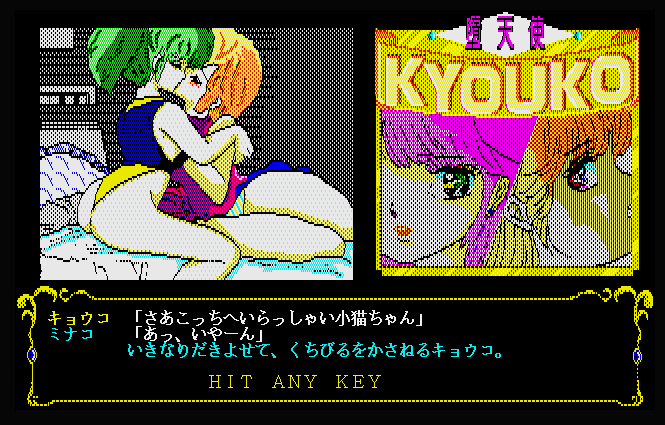
The way this list ended up is; in this first part I summarise what I found about porn games I never played, from the late 1980s to the early 1990s; in Part 2 I talk about console games with non-pornographic sapphic content from the late 1990s, including my own memories/reviews of those I played back in the day.
Touching Grass: The Game is a solo journaling game played with pen and paper, a deck of Tarot cards, and the plants outside. Touching Grass: The Game is a ludditoludic technoparanoid hallucinatory amusement about the notions of modern technology as a mind-controlling conspiracy; of proximity to plants as magically inducing psychological growth; of “touching grass” as a demanding ascetic exercise in a world of addictive distractions. I have distilled these common feelings until the exhortation to touch grass became an exercise in recreational psychosis.
To finish Touching Grass: The Game, you will need to go outside somewhere between 8 to 78 times, depending on how you play it, the phase of the moon, and your luck. I suggest planning for one outing a day for a couple lunar cycles. If you complete Touching Grass: The Game at least once, you may publicly present yourself as a Phytocultist of the Green Gate.
One of the biggest reliefs ever for me was to find out that native English speakers often can't make out the lyrics of songs either. That native English speakers also feel like modern TV is better watched with subtitles. In the same way, one of the biggest reliefs was finding out that native Japanese gamer also have no fucking clue what the hell Amakusa Shirō-Tokisada is mumbling on Samurai Shodown IV (=Ten-samu). The voice capabilities of the old videogames was quite crunchy, and recordings often only vaguely resembled the original sample. (Somebody could probably do a phonetics paper on this.)
We live in a society that incentivises productivity and consumption, and devalues maintenance, cleaning, repurposing, degrowth; even though the first type of thing is destroying the world and the second type of thing is what is needed to avert collapse. In fact, perversely, the more problems are created by productive labour the greater its prestige, because doubling down is a method of denial.