Liza Hadiz

worldwar1

In November 2025, Sotheby’s sold the most expensive modern artwork ever at auction—for $236.4 million. The painting is not only a Viennese Secession-Art Nouveau masterpiece that prompted collectors to bid generously, but it also has a fascinating history behind it—what it stood for and how it was part of a campaign to control cultural meaning.

When modernist style was labeled degenerate art

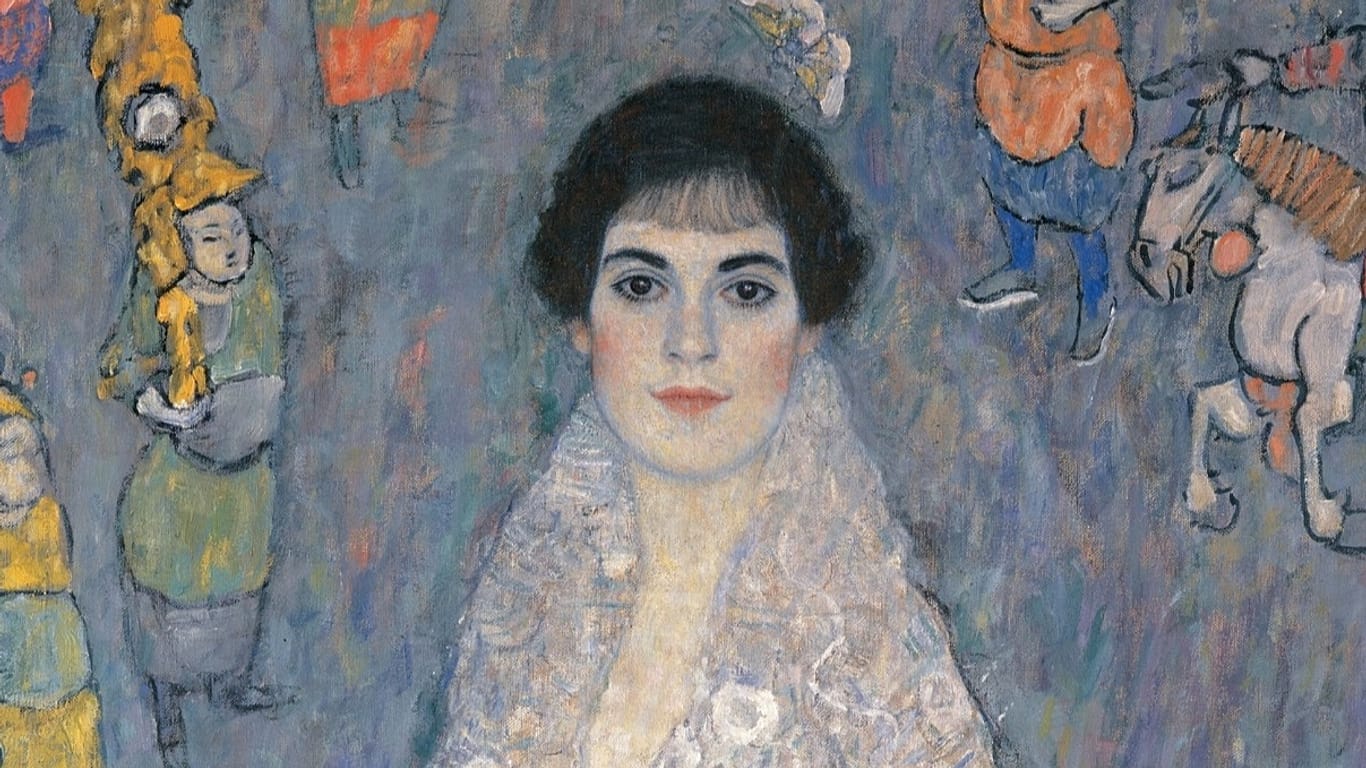
Gustav Klimt’s painting of 20-year-old Elisabeth Lederer, daughter of Vienna’s Jewish cultural elite and patron, was completed in 1916, just two years before the death of the artist. After the 1938 annexation of Austria, it was seized by the Nazis. Remarkably, it escaped destruction, and then found its way back to the family, and entered Leonard Lauder’s collection in the 1980s. What makes the story fascinating is that Elisabeth herself, then in her forties, was saved from prosecution because of the portrait. Klimt had become an internationally acclaimed artist by that time, Elisabeth’s arrest would have brought attention to Nazi persecutions. According to contemporary accounts, Elisabeth even claimed that Klimt, who was not Jewish, was her father.

The Nazi regime of the Third Reich systematically confiscated art that did not conform to its ideology. Styles deemed “un-German”, including modernism, such as expressed in the Art Nouveau movement (or Jugendstil, as it was known in Germany), were frequently targeted. They were denounced as “degenerate art” because of their modernist style and cosmopolitan nuance—blending influences from Asia and other parts of the globe—and moreover, because of the artists’ tie with wealthy Jewish patrons.

Portrait of Elisabeth Lederer by Gustav Klimt

Portrait of Elisabeth Lederer by Gustav Klimt. (wikimedia.org)

Art Nouveau emerged as a revolt against historicism

Art Nouveau (roughly 1890–1910) is commonly described as a form of decorative modernism, notable for its long, sinuous lines, organic motifs, and Japonisme and other Asian influences. This is demonstrated in the portrait of Elisabeth, where a Japanese-inspired patterning decorates the background. Art Nouveau, often associated with Brussels, emerged as a revolt against the historicism of 19th century art.

With a craft‑centered ethos that sought to unify fine and applied arts, Art Nouveau—influenced by the earlier Arts and Crafts movement in Britain—regarded factory production as producing low-quality goods that degraded both objects and workers. Art Nouveau’s emphasis on artisanal skill was a response to industrial modernity. While the movement did not reject technology, it objected to the lack of artistry in mass production and sought to elevate decorative handwork and craft as a means of social and aesthetic reform.

Art Nouveau was a movement with a social and political agenda

Art Nouveau was avant-garde, the style of the new generation and emergent bourgeoisie eager to distinguish themselves from the old nobility and conservative society. While largely an urban and often elitist movement, it sought to improve everyday life—promoting well-being, a renewed connection to nature, and greater beauty and functionality in the domestic environment—not just for the wealthy but also the working class.

Interestingly, Art Nouveau developed its distinct regional traits across Europe. For example, dominant colors signal local identity: Vienna used black and white; Brussels identified with orange and green; Spain favored bright, saturated colors; and Italy chose soft pastels and earthy tones. In some regions, the style carried a political statement, such as in Finland, Art Nouveau motifs became associated with cultural and political emancipation from Russia. In the Czech lands and Poland, folk motifs and historic references with modern forms were blended to assert national culture under imperial rule. Similarly, in Catalonia, Art Nouveau was an expression of the people’s struggle for independence.
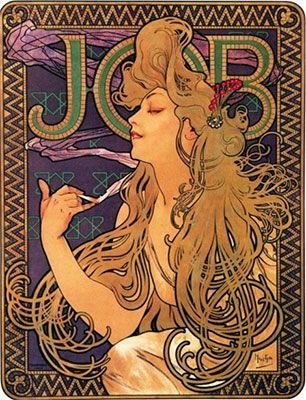
A somewhat scandalized advertisement for the Job cigarette company circa 1896 by Czech painter and graphic artist Alphonse Mucha who became the defining figure of Art Nouveau

A somewhat scandalized advertisement for the Job cigarette company (1896) by Czech painter and graphic artist Alphonse Mucha who became the defining figure of Art Nouveau. (theartstory.org)

Thus, Art Nouveau functioned as a coherent movement with a social and political agenda: achieving societal progress and sovereignty.

Inevitably, Art Nouveau lost its popularity after World War I following the collapse of traditional patronage and a postwar recovery that needed mass production, consumerism, and affordable design. Despite this fact, when the Nazi regime came into power decades later, it still confiscated Art Nouveau and other modernist works for their perceived internationalism, moral inferiority, and past associations with Jewish patrons.

Art Deco became a symbol of multiculturalism, cosmopolitan and urban lifestyle

As the Art Nouveau movement waned in the 1910s, what would become Art Deco in the 1920s began to emerge. This new art movement, closely associated with Paris, echoed the shift in design philosophy that was in line with the postwar years of rebuilding. With its simple design for easy production and reproducibility, it reflected the rapid industrialization and vast technological advancements taking place. Its clean lines, bold colors, and streamlined geometric forms symbolized modernity, progress, structure, and order, but its decorative richness separated it from modernism. Patterns of zigzags, square spirals, and aerodynamic curves reflected international grandeur and glamour. Art Deco too drew inspiration from various cultures, including Africa, Asia, and the Americas, as well as from different historical periods—symbolizing postwar multiculturalism, and an urban, cosmopolitan lifestyle.

Côte d’Azur Pullman Express poster circa 1929 was designed by French artist Fix‑Masseau who worked in the Art Deco idiom that dominated railway and travel posters of the late 1920s and 1930s

The Côte d’Azur Pullman Express poster (1929) was designed by French artist Fix‑Masseau who worked in the Art Deco idiom that dominated railway and travel posters of the late 1920s and 1930s. (peoplesgdarchive.org)

While Art Nouveau was reformist and artisanal oriented, Art Deco had revolutionized design for a modern machine‑age society.

Art Deco, like Art Nouveau, was elitist at its height

Art Deco shaped the designs of public goods, such as transportation and social housing, but like Art Nouveau, it remained elitist at its height. With its consumerist ethos, the style represented the interests of the urban middle class with spending power. In this way, Art Deco functioned as an innovative and progressive force in the development of modern industrial capitalism, where mass products with short lifespan were created to stimulate demand.

Post–World War I witnessed the rise of a consumer-oriented middle class which benefited from interwar economic expansion, gradually replacing the dominance of the old aristocratic and bourgeois elites. At the same time, the middle class distinguished itself from working‑class and socialist aesthetics, defining its identity through upwardly mobile urbanity, a lifestyle of consumerism and modernity, and the professional status of white‑collar employment. Among this emerging class was the emancipated “New Woman” of the Weimar era which ended in 1933.

Art Deco inspired designs were used to signify progress

The Nazi campaign sought to systematically control cultural meaning. From 1933 onward, all art was regulated by the Reich Ministry of Popular Enlightenment and Propaganda. Any work not aligned to Nazi ideology of Aryan purity and nationalism was targeted. Both Art Nouveau and Art Deco, with their hybrid concepts and modernist styles, were condemned as corrupt by a regime that upheld the supposed superiority of Greek and Roman classical art.

Poster created by commercial illustrator and poster artist Ludwig Hohlwein for Deutsche Lufthansa in 1936 promoting the Berlin Summer Olympics and reflecting nationalistic pride

Poster created by commercial illustrator and poster artist Ludwig Hohlwein for Deutsche Lufthansa in 1936, promoting the Berlin Summer Olympics and reflecting nationalistic pride. (pinterest.com)

Nevertheless, when the regime could benefit from a style, it adapted it for political purposes. This is the case with Art Deco, the prevailing design trend during Nazis’ rise to power. In posters and other propaganda media, the regime used Art Deco-inspired elements—streamlined geometry and bold palette—to signify progress, structure, order, discipline, and heroism, in order to persuade and mobilize the population, especially the youth.

The regime mastered the art of controlling cultural meaning

The Nazi regime implemented selective suppression in its cultural policies. Rather than fully banning everything that conflicted with its ideology, the regime instead systematically censored, repressed, or reshaped representations. For example, in the case of the gender ideology that the “New Woman” symbolized, the regime restricted or banned publications that promoted it. Lesbian periodicals such as Die Freundin and Frauenliebe/Garçonne were banned, while liberal magazines such as Die Dame and Berliner Illustrirte Zeitung were adapted or coopted to align with Nazi objectives. At the same time, the regime consistently propagated an alternative imagery of womanhood that emphasized motherhood and patriotism, which would eventually dismantle the “New Woman”.

Cover of the German fashion and lifestyle magazine Die Dame, depicting the style of the New Woman, published in March 1929

Cover of the German fashion and lifestyle magazine Die Dame, depicting the style of the New Woman, published in March 1929. (wikimedia.org)

Thus, the story behind Gustav Klimt’s painting of Elisabeth Lederer demonstrates how art—just as other media in its various forms—can be used as a tool to control society, uphold ideology, and legitimize power, whether completely suppressed by being banned, or coopted, adapted, and reshaped to serve those in power. Art Nouveau was one of the modernist art forms frequently targeted for banning, while elements of Art Deco were often adapted and reshaped to conform to the Nazi regime’s cultural and political rhetoric. This illustrates one of the many ways in which a regime could master the art of controlling cultural meaning: art, far beyond aesthetics, becomes a political instrument.

-Some Thoughts from the Cappuccino Girl- (2025)

#history #art #fascism #Germany #WorldWar1

You might be interested to read: The Salute of Tyranny From Global Power to Existential Anxieties: How Colonialism and Migration Shape the UK

Top image: Euronews.com
Sources
Greenhalgh, Paul (2000) ‘Art Nouveau: Politics and Style.’ History Today Vol. 50 Issue 4 April. https://www.historytoday.com/archive/art-nouveau-politics-and-style [22 November 2025].
Horth, Elisabeth (2009) The Social Agenda of Art Nouveau. Collectors Weekly. https://www.collectorsweekly.com/articles/guest-column-the-social-agenda-of-art-nouveau [22 November 2025].
Mallya, Sanjana (n.d.) Art Deco and Its Global Influences. Rethinking the Future. https://www.re-thinkingthefuture.com/architectural-community/a11195-art-deco-and-its-global-influences [22 November 2025].
Middlemiss, Matteo (2018) Why Was Art Nouveau the Art Revolt People Were looking for? The Flame Tree Blog. https://blog.flametreepublishing.com/art-of-fine-gifts/why-was-art-nouveau-the-art-revolt-people-were-looking-for [21 November 2025].
Myrvang, Christine (2015) Art Deco: The Era That Lingers in Spirit. BI Norwegian Business School. https://www.bi.no/en/research/business-review/articles/2015/09/art-deco-the-era-that-lingers-in-spirit-/ [22 November 2025].
Pound, Cath (2018) What Art Nouveau Can Teach Us about National Identity. BBC. https://www.bbc.com/culture/article/20180525-what-art-nouveau-can-teach-us-about-national-identity [22 November 2025].
Smith, Elizabeth Anne (2025) Beauty in the Face of Horror: Fashion, Femininity, and Identity During the Holocaust. Thesis. Washington State University. Online PDF document [29 November 2025].
Wikipedia (2025) Berliner Illustrirte Zeitung. https://en.wikipedia.org/wiki/Berliner_Illustrirte_Zeitung [29 November 2025].
Wikipedia (2024) Die Freundin. https://en.wikipedia.org/wiki/Die_Freundin [29 November 2025].

POPULAR TOPICS #subculture Gurlesque: Poetics of the Bizarre, Ugly, and Feminine #films Mrs. Robinson, Countercultures, and Politics #history The Dutch Golden Age, Golden for Whom? I also write articles here: https://feministpassion.blogspot.com/

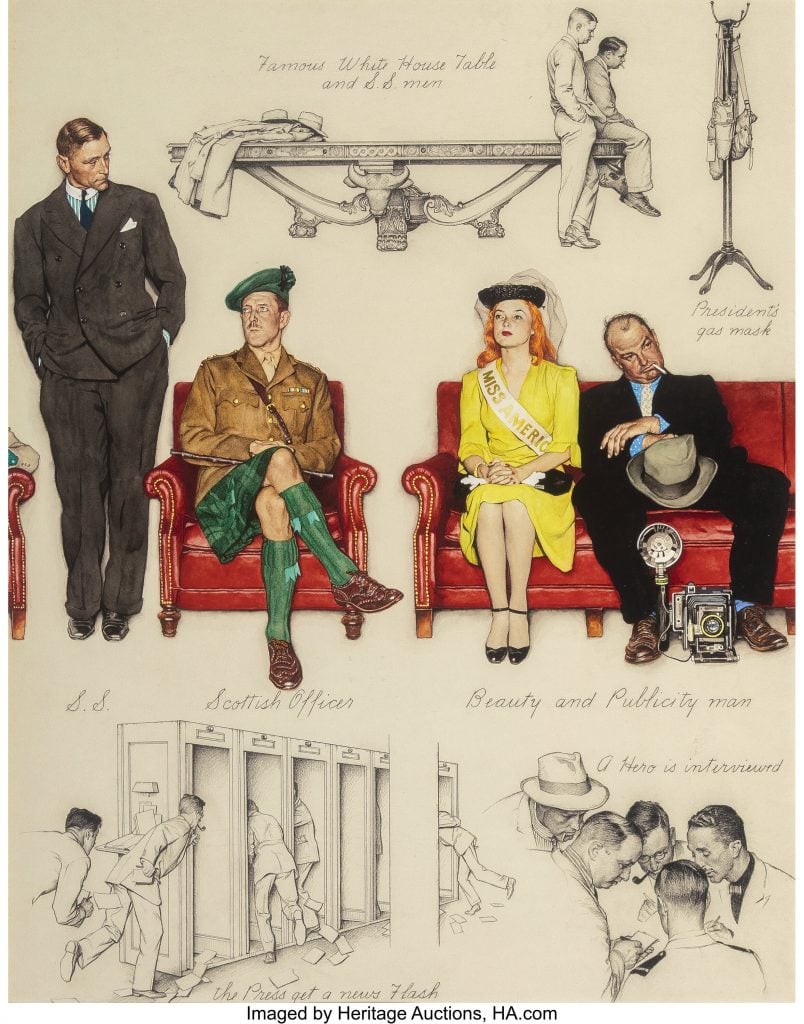
So You Want to See the President!, that's the title of the four-panel suite of paintings that, for decades, hung in the White House. Painted in 1943 by celebrated American artist Norman Rockwell, the suite portrays the waiting area outside the Oval Office, where citizens from various professions and officials gathered in hopes to meet the President. The paintings captured the democratic spirit of the era. At the height of World War II, it reflected a unifying vision of American society.

Amid the anxieties of wartime and economic uncertainty, Rockwell crafted images that evoked the nostalgia of the American Golden Age, depicting the comforts of family life and a secure home. Mainstream media often promoted this image of prosperity—which Rockwell was able to translate so well onto his canvas—to soften the realities of economic hardship and racial tension. Conservative outlets like The Saturday Evening Post used the psychology of nostalgia to soothe public unease rooted in economic vulnerability and to foster a sense of cohesion amid a racialized society. Norman Rockwell would later become a cultural icon, best known for his illustrations in The Saturday Evening Post, from the interwar years to the early decades of the Cold War.

The post-First World War period was marked by economic expansion and rapid growth, followed by a flourishing cultural environment and shifting social norms, epitomized by the emergence of the flapper counterculture. It was also a time of political progress as women finally secured the right to vote. Yet the Roaring Twenties was also a decade of economic disparity—low wages for the urban working class and persistent hardship for rural Americans—leaving many vulnerable. Not surprisingly, it was a period of continued racial tensions, marked by the resurgence of the Ku Klux Klan and the passage of the restrictive Immigration Act of 1924.

Interestingly, Rockwell’s celebrated depictions of the idealized male breadwinner nuclear family—spanning over four decades—continue to resonate with segments of the American public today.

Nevertheless, under the strict editorial direction of The Saturday Evening Post, Rockwell’s images not only masked the social tensions but also obscured the shifting norms reshaping American society. Readers were deflected from reality by scenes that told the story of a stable and harmonious American society centered on the “typical” male breadwinner and female homemaker nuclear family. Absent in these images were the independent flappers and hardly visible were the working-class, particularly women, both white and of color.

Twenty-five years later, the welfare policies and economic boom of post-World War II made the idealized male breadwinner family attainable, although very briefly, for middle-class and upper-class households. Yet this image of mainly white, suburban families, continued to be perpetuated by mainstream media for decades. It was an image that also aligned with the US government’s Cold War narrative, which promoted the nuclear family as a symbol of capitalist superiority in contrast to the collectivist ideals of communism.

Following the civil rights movement that shifted perceptions about society, new laws and policies were enacted to reduce racial and gender inequality. These reforms transformed social norms and values around family and sexuality, and shaped institutions. However, not all segments of society embraced these changes. Rockwell himself grew weary of the editorial constraints imposed by The Saturday Evening Post and, in 1963, left to work for Look magazine. There, he crafted some of his most controversial works that confronted the inequalities and tensions shaping America.

Like feminism, the far-right views women’s role in care work as undervalued by society; however, far-right supporters generally attribute this to the cultural hegemony of neoliberalism and liberal feminism.

Interestingly, Rockwell’s celebrated depictions of the idealized male breadwinner nuclear family—spanning over four decades—continue to resonate with segments of the American public today. On various digital platforms, some women from diverse ethnic backgrounds who support far-right ideologies have expressed dissatisfaction with contemporary society, describing a sense of peace and empowerment upon embracing traditional gender roles. This discontent often cites feminism for promoting a perception that privileges professional women over traditional homemakers—diminishing the cultural value of housewives and of men as primary providers and protectors.

Like feminism, the far-right views women’s role in care work as undervalued by society; however, far-right supporters generally attribute this to the cultural hegemony of neoliberalism and liberal feminism. This hegemony, in their view, has stigmatized traditional values and gender roles, where masculinity is more often loathed than encouraged and men are no longer seen as women’s protector, both in the social and economic sense. Such cultural dominance, they argue, are among the factors contributing to the decline of what they consider “true American values.”

Furthermore, the hegemony that promotes multiculturalism and diversity is perceived by far-right supporters as contributing to unresolved societal issues, such as job insecurity, limited access to public goods, and increase in crime rates, including violence against women. The increase in immigration is often cited as a cause of these problems even when such claims are not reflected in data and statistics.

The far-right movement, therefore, seeks to restore traditional “native” values as a way of deconstructing what they perceive as a broken society. However, the dissatisfaction is often attributed to shifting cultural norms, while in fact, it stems from systemic issues. The lack of accessible and trustworthy childcare, the absence of family-friendly labor policies, and the persistence of traditional gender roles that impose a double burden on women all contribute to the difficulties faced by many—particularly mothers.

Scholars interpret this as a backlash against the failure of neoliberal governance to deliver broad-based economic security and social cohesion.

Moreover, the movement asserts that saving America from perceived cultural decadence requires strengthening a monocultural national identity and reasserting national control over the economy, as economic sovereignty is framed as a moral imperative to restore traditional family values and cultural order. This vision reflects its supporters’ economic anxieties and fears of cultural displacement. Scholars interpret this as a backlash against the failure of neoliberal governance to deliver broad-based economic security and social cohesion.

Scholars have observed that neoliberal policies in the United States have deepened inequality: wages have stagnated for much of the working class, labor protections and social safety nets have eroded, and corporate profits have soared—concentrating wealth at the top. Privatization and deregulation have rendered public goods such as higher education, healthcare, and housing increasingly unaffordable. Critics of neoliberalism argue that policies prioritizing market efficiency over social equity have fueled job insecurity, housing shortages, rising rents, and racialized vulnerability. These systemic failures have contributed to cultural fragmentation, institutional distrust, and adverse political polarization.

So You Want to See the President!—which was commissioned in 1943 by Stephen T. Early, Roosevelt’s press secretary—depicted various groups in American society, conveying a unifying vision of democracy. Yet it reflects a white, middle-class lens on civic participation, mirroring the exclusionary politics and cultural norms of its time, in which structural diversity and inequality were obscured. The suite was removed from the White House in 2022 following a family ownership dispute and is scheduled for auction. While the paintings hold significant historical value, the suite’s removal is timely given that the country seriously needs to bridge political polarization. To move forward, reflection is urgently needed to envision a post-neoliberal governance that centers equity, care economies, labor protections, and democratic accountability, while dismantling structures that perpetuate marginalization and safeguard concentrated wealth.

-Some Thoughts from the Cappuccino Girl- (2025)

#history #art #WorldWar1 #WorldWar2 #US #Politics #feminism

You might be interested to read: From Global Power to Existential Anxieties: How Colonialism and Migration Shape the UK

Image: Artnet News
Sources:
Ainsworth, Garrett (2024) ‘Why Neoliberalism Has Failed Us: How Republican Economic Policies Promote Inequality.’ Michigan Journal of Economics. https://sites.lsa.umich.edu/mje/2024/03/18/why-neoliberalism-has-failed-us-how-republican-economic-policies-promote-inequality/ [8 November 2025].
Bradatan, Anastasia (2023) The Overlooked Roles of Women in Far-Right Extremist Organizations and How to Prevent Their Further Radicalization. Fordham Law Voting Rights and Democracy Project. https://fordhamdemocracyproject.com/2023/04/26/the-overlooked-roles-of-women-in-far-right-extremist-organizations [19 October 2025].
Campion, Kristy and Kiriloi M. Ingram (2023) ‘Far-right “Tradwives” See Feminism as Evil.’ Their Lifestyles Push Back Against ‘the Lie of Equality.’ The Conversation. https://theconversation.com/far-right-tradwives-see-feminism-as-evil-their-lifestyles-push-back-against-the-lie-of-equality-219000 [19 October 2025].
Cohen, Alina (2025) ‘Norman Rockwell Paintings That Once Hung in the White House Bound for Auction.’ Artnet News. https://news.artnet.com/market/norman-rockwell-president-white-house-paintings-auction-2704973 [4 November 2025].
Joppke, Christian (2024) ‘Neoliberal Nationalism and Immigration Policy.’ Journal of Ethnic and Migration Studies. https://www.tandfonline.com/doi/pdf/10.1080/1369183X.2024.2315349 [8 November 2025].
Leidig, Eviane (2021) “We Are Worth Fighting for”: Women in Far-Right Extremism. International Centre for Counter-Terrorism – ICCT. https://icct.nl/publication/we-are-worth-fighting-women-far-right-extremism [19 October 2025].
Shams, Shahrzad, Deepak Bhargava, and Harry W. Hanbury (2024) ‘The Cultural Contradictions of Neoliberalism: The Longing for an Alternative Order and the Future of Multiracial Democracy in an Age of Authoritarianism.’ The Roosevelt Institute. https://rooseveltinstitute.org [8 November 2025].
Stiglitz, Joseph (2024) ‘How Neoliberalism Failed, and What a Better Society Could Look Like.’ Working Paper. Roosevelt Institute. https://rooseveltinstitute.org [8 November 2025].
Williams, Katherine (2024) Women's Engagement with the Far Right: A Quest for a More Holistic Understanding. Compass Hub. https://compass.onlinelibrary.wiley.com/doi/10.1111/rec3.12495 [19 October 2025].
Zamora, Daniel and Niklas Olsen (2019) How Decades of Neoliberalism Led to the Era of Right-Wing Populism. Jacobin.com. https://jacobin.com/2019/09/in-the-ruins-of-neoliberalism-wendy-brown [8 November 2025].

POPULAR TOPICS #subculture Gurlesque: Poetics of the Bizarre, Ugly, and Feminine #films Mrs. Robinson, Countercultures, and Politics #history The Dutch Golden Age, Golden for Whom? I also write articles here: https://feministpassion.blogspot.com/
The nineteenth to twentieth century in western Europe was a period when the intellectual community and the cultural and art movements flourished. Austria, particularly Vienna, and the Weimar Republic, particularly Berlin, were the centers of these cultural movements where the salon and coffeehouse culture grew. During this period, women enjoyed inclusion in some areas of the public sphere, while economic and political discrimination prevails. The wars, power struggles, and economic and political instabilities all played a role in women’s changing position in society at the onset of fascism.

Vienna, the multicultural city of immigrants in the 19th century, was famous for its European salon culture. Conceived by the middle and upper classes, the salons provided the medium for intellectual discussion and critical thinking. Moreover, the salons provided a space for the integration of the Jewish immigrants into society's elites. The salon culture was also a means of acculturation and emancipation for Jewish women. In Vienna and Berlin, many of these salons were hosted by educated Jewish women. The salon culture, however, was soon replaced by the more accessible and popular coffeehouse culture.

In 19th century Vienna and Berlin, coffeehouses became a meeting place for people from diverse backgrounds, including the less wealthy, and served as a place for intellectuals to exchange ideas and hold discussions. The coffeehouse culture was closely associated with the Jewish intellectual and artistic community. However, coffeehouses excluded women, supporting the conservative gender ideology of the time.

The coffeehouses grew to become an important part of Viennese multicultural urban life. Viennese coffeehouses gave birth to a new generation of movements, such as the Young Vienna modernist literary movement which was spearheaded by male Jewish intellectuals. Vienna’s intellectual community thrived to influence ideas which developed throughout Europe.

Nonetheless the inevitable was to come. The influx of immigrants crowded the city and affected the workforce, turning Vienna into a breeding ground for conservatism, nationalism, and anti-Semitism. In the last decade of the century up to 1914—known as the “Fin-de-Siècle” or turn of the century—the coffeehouse culture faced the challenge of rising anti-Semitism, while the salons continued to decline due to prevalent misogyny and antifeminism.

The golden age of liberalism ended in 1895 when conservative powers took over. This was followed by a weakening middle class and the quite death of the salons. The coffeehouse intellectuals who played an important role in the advancement of liberalism were fighting a losing battle.

Politics took another turn after the First World War. A strong labor and feminist movement grew out of the postwar crisis in Vienna and had set the motion for radical changes in policies which favored the working class, including the women. “Red Vienna”, home to migrant laborers from across the empire, became the haven for workers’ power.

Unsuspectedly too, the Great War was like a blessing in disguise for the women of the Weimar Republic (Germany in 1918–1933). Before the war, Germany was a constitutional monarchy with a parliament elected by adult males. After the war, with the removal of the Kaiser, Germany became a republic with representative democracy. Women were given political and economic rights. Besides gaining the right to vote, women were also granted equality in marriage and the professions.

The new independent woman of the Weimar Republic was coined the “New Woman” and she became the icon of the republic’s golden liberal era and the face of popular media. After women had a taste of economic independence when working during wartime to replace men, many continued to work and enjoyed an active social life. Women were able to do what was unthinkable just a few years before: enjoy the single life, smoke, drink, drive a car, and dance in jazz clubs. The coffeehouses were no longer a male domain as it were before the war; women were free to roam the coffeehouses unchaperoned. In Berlin, the center of Weimar culture, well-known Jewish women writers and artists were regulars at coffeehouses, such as the Romanisch Café.

However, unlike the image of the New Woman and its café lifestyle—which was sexualized and exploited by the media—in reality, women continued to face economic and political discrimination under Weimar liberalism. After supporting the workforce in wartime, the majority of working women became menial workers with the re-employment of men and then used as cheap labor. Meanwhile, in politics, women only had access to areas related to the home and family, such as health, education, and religion.

So, when politics took a different turn and the Nazis came to power—they, although rather ironically, had the blessings of the Weimar women. War reparations, hyperinflation, the collapse of the economy in 1923, and the Depression that followed had the republic on its knees. The economic crisis and a weakened government paved the way for the fascist party, which many, including the Weimar women, saw as offering the only hope for rebuilding the country. With no real political role to play, Weimar women leaders looked to Hitler to secure their political positions and thus gave their support to the Nazi party. Unfortunately, this was poor judgement.

Weimar’s fall in 1933 was followed by Red Vienna succumbing to the economic and political pressure of the conservative federal state in 1934. The end of the Weimar Republic and the annexation of Austria by Nazi Germany in 1938 saw an exodus of the Jewish population which had played an important role in the development of both countries. Subsequently, women were reduced to their reproductive role under fascist ideology. The crises and weakened regimes provided fascism with the means to rise to power by convincing many that it will transcend liberalism, democracy, and socialism.

-Some Thoughts from the Cappuccino Girl- (2022)

Image: Painting by German artist Jeanne Mammen, 1927

#Vienna #Austria #Weimar #Germany #salonculture #coffeehouseculture #women #gender #fascism #politics #history #worldwar1 #worldwar2 #Europe

I have written about the above topics before, if you're interested, read:

More about Vienna and its coffeehouse culture: https://feministpassion.blogspot.com/2018/05/turn-of-century-vienna-liberalism.html

More about the Weimar New Woman: https://feministpassion.blogspot.com/2020/04/from-weimar-new-woman-to-mother-of.html

Sources
BBC Bitesize (2022) The Growth of Democracy in Germany, 1890-1929. https://www.bbc.co.uk/bitesize/guides/zcwxrdm/revision/2. (Accessed 29 January 2022).
Buzynski, Isabella and Kai Mishuris (2014) ‘Jewish Café Culture in Berlin.’ ArcGIS StoryMaps. https://storymaps.arcgis.com/stories/73fce8a685b64bb29fe87715bf72dc12 (Accessed 29 January 2022).
Galerie St. Etienne (2006) More Than Coffee was Served, Café Culture in Fin-de-Siècle Vienna and Weimar Germany. https://www.gseart.com/exhibitions-essay/1016 (Accessed 30 January 2022).
Mann, Michael (2004) 'The Rise and Fall of Fascism.' UCLA Book Reviews. https://escholarship.org/uc/item/9pg469w2 (Accessed 30 January 2022).
Schirn.de (2017) Splendor and Misery in the Weimar Republic. http://www.schirn.de/glanzundelend/digitorial/en (Accessed 30 January 2022).
Wilhelmy-Dollinger, Petra (1999) ‘Berlin Salons: Late Eighteenth to Early Twentieth Century.’ Shalvi/Hyman Encyclopedia of Jewish Women. Jewish Women's Archive. https://jwa.org/encyclopedia/article/berlin-salons-late-eighteenth-to-early-twentieth-century. (Accessed 30 January 2022).

POPULAR TOPICS #subculture Gurlesque: Poetics of the Bizarre, Ugly, and Feminine #films Mrs. Robinson, Countercultures, and Politics #history The Dutch Golden Age, Golden for Whom? I also write articles here: https://feministpassion.blogspot.com/

“Calling to arms all men from 21 to 55 years old, Italy can mobilize 8,000,000 men, and adding young men of 18, 19, and 20 years more than 9,000,000 ….”

The nation’s leader, Benito Mussolini—or better known as II Duce to his people—did not fail to cast a spell on the cheering crowd on the 30th of March 1938. His speech continued to spark the crowd as he shouted,

“This shows how ridiculous are the polemics of certain circles beyond the Alps according to which the African war, the formation of two army corps in Libya and the participation of volunteers in the Spanish war have weakened us.

On the contrary, all that strengthened us …”

In fascist Italy, the modern Italian man is what makes up the nation—he is the nation, the nation is him. War was no longer seen as misery, but an honor. It was a time of great hope and pride as II Duce attempted to revive the glory of the Roman Empire. The men were the soldiers; the women were mothers who earned medals for supplying the nation with its soldiers and workers.

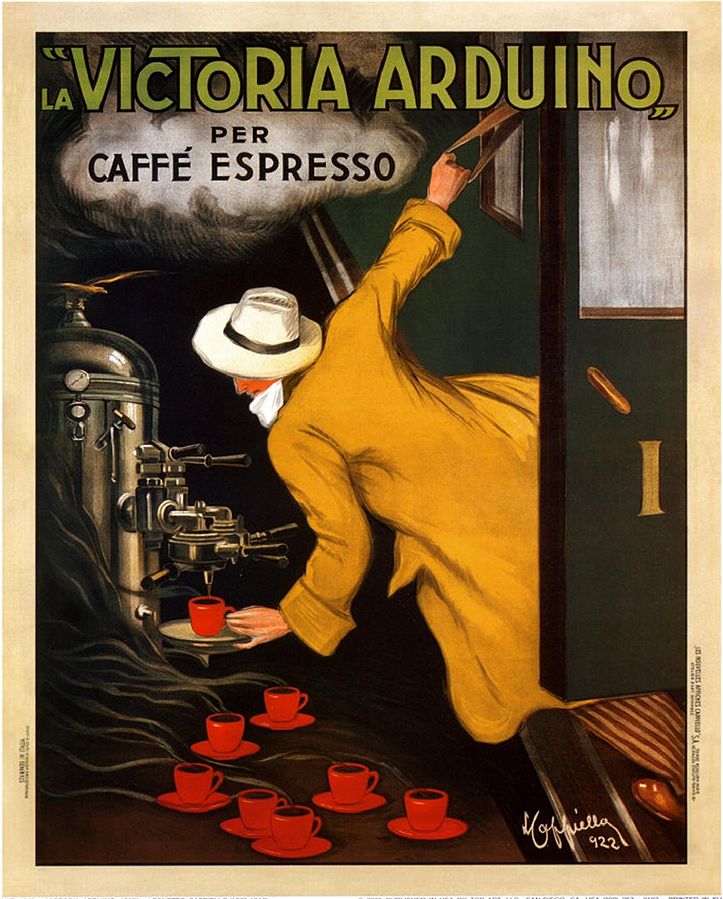
The fascist regime promoted espresso to the workers. In the morning, workers line up against the counters of espresso bars, sipping their cups only for minutes, before dashing off to work for the nation. The new steam espresso machine makes coffee fast like a speeding steam train, but just cool enough to immediately drink. In only seconds the espresso will flow smoothly from the machine like a long mouse tail into the small cups, an analogy with the steam trains, which in a split second, will arrive at the stations as scheduled. Even though the promptness of the trains was false, both the train and the espresso machine served as Mussolini’s propaganda to demonstrate the technological advancement, industrialization, and modernization of what was once a war-torn Italy.

The nation was trying to rise from its knees by the lift of a strongman as the memory of the First World War had slowly dwindled but not forgotten. For Mussolini, founder of Italy’s National Fascist Party—the Italian espresso was the nation’s drink, that of a modern Italy. For the nation’s strongman, it was political as much as cultural.

Looking back, who would have thought that the strongman, who vowed to lift Italy from the trenches, would be executed in humiliation as he was by the people of his country? On April 28, 1945, Mussolini was captured while trying to flee with his mistress.

The empire Mussolini aspired to build did not, by far, have the military skills of the Romans. The dictator who was responsible for the war losses and death of his people had left his wife of three decades and their children to escape and save himself.

Even more humiliating was what happened after his death. On April 29th, 1945, the bodies of II Duce and his mistress, Clara Petacci, and three supporters who were executed along with them, were hanged upside down at the town square of Milan to satisfy the angry mob. This event is what is best remembered of the strongman who fell from grace.

Nonetheless, the Italian espresso and the coffee bars that Mussolini used in his fascist propaganda were quickly disassociated with the strongman. The Italian espresso culture lived on to be celebrated around the world.

-Some Thoughts from the Cappuccino Girl- (2021)

#fascism #WorldWar1 #WorldWar2 #Italy #Espresso #history

Note: Mussolini’s speech is quoted from: http://bibliotecafascista.blogspot.com/2012/03/speech-in-senate-march-30-1938.html.

I first wrote this piece as a historical fiction short story, although it may have not turned out too well. In case you are interested, you can read it here: The Strongman's Espresso https://feministpassion.blogspot.com/2021/06/the-strongmans-espresso.html.

POPULAR TOPICS #subculture Gurlesque: Poetics of the Bizarre, Ugly, and Feminine #films Mrs. Robinson, Countercultures, and Politics #history The Dutch Golden Age, Golden for Whom? I also write articles here: https://feministpassion.blogspot.com/
The moral devastation experienced by the US after the Great War led the country to the quest of achieving a new stability. This was sought through regaining economic strength and retaining traditional values. It was during this aftermath that many American modernist writers, in search of a safe haven, emigrated to Europe. Many settled in Paris, finding the freedom that could release them from the disillusionment caused by the war.

For many years Paris was home to American modernist writers, poets, and artists during an era of postwar recovery and prefascist political power. These writers were then known as “the Lost Generation”—those who due to the war had lost their faith in the government, God, and the American dream.

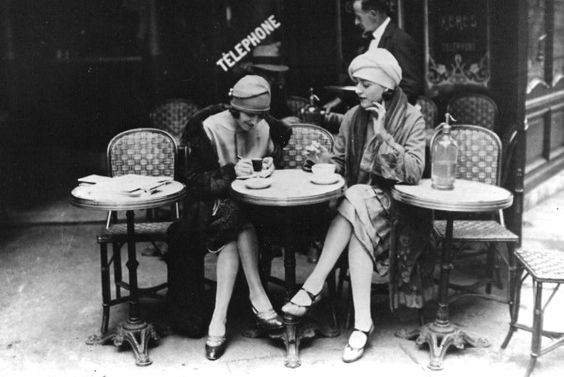
Even with the economic and social independence that American women gained in the roaring '20s, the literary and art scene still offered less freedom to women. This led many American female writers and artists to join the emigration to France in the 1920s and '30s. Among these women were Gertrude Stein, Djuna Barnes, Solita Solano, and Thelma Wood, just to name a few. However, “the Lost Generation”, a term first coined by Stein, remained associated mainly with male writers, such as Ernest Hemingway and F. Scott Fitzgerald—the major heroes of this generation.

In the 1920s and 30s, Paris had inspired women modernist writers and artists as the city gave them freedom to live an alternative lifestyle to that of the conservative postwar American society. These Parisian women, who led the unmarried, bohemian, and bisexual lifestyle, were later dubbed the “Left Bank women writers”, as they famously resided in this part of Paris. Their work and lifestyle quickly became a subculture within the male dominated literary and art community of American modernists.

The Left Bank women writers were less acknowledged in modernist literature than their male peers. They were eventually recognized but labeled as “women writers” or “lesbian writers”. Some writers find this separate category of recognition as derogatory. Barnes, who is well-known for her classic novel, Nightwood (1936) which was influenced by her relationship with Wood, once said, “I hate women writers!” and wanted to disassociate her work from this label. The category had emerged owing to the absence of white heterosexual male bias (albeit still predominantly white) in the works of Left Bank women writers. Despite this, arguably, the category may have kept the work of Left Bank women writers at the margins of the modernist literary movement.

The male comrades of the Lost Generation emerged from a state of cultural changes and turbulent times. Even though breaking with traditional literary conventions, they were often criticized for preserving a predominantly masculine culture; thus, contributing to modernism’s marginalization of women.

Photo: Solita Solano and Djuna Barnes in a Paris cafe around 1922 (Maurice Brange)

-Some Thoughts from the Cappuccino Girl- (2021)

#literature #Worldwar1 #womenwriters #lostgeneration #history #US #Paris #gender #women #subculture #counterculture

If you are interested in this topic, you might like to read: Unsung Women Writers of the Postwar Era https://feministpassion.blogspot.com/2019/03/unsung-women-writers-of-postwar-era.html

POPULAR TOPICS #subculture Gurlesque: Poetics of the Bizarre, Ugly, and Feminine #films Mrs. Robinson, Countercultures, and Politics #history The Dutch Golden Age, Golden for Whom? I also write articles here: https://feministpassion.blogspot.com/