Liza Hadiz

worldwar2

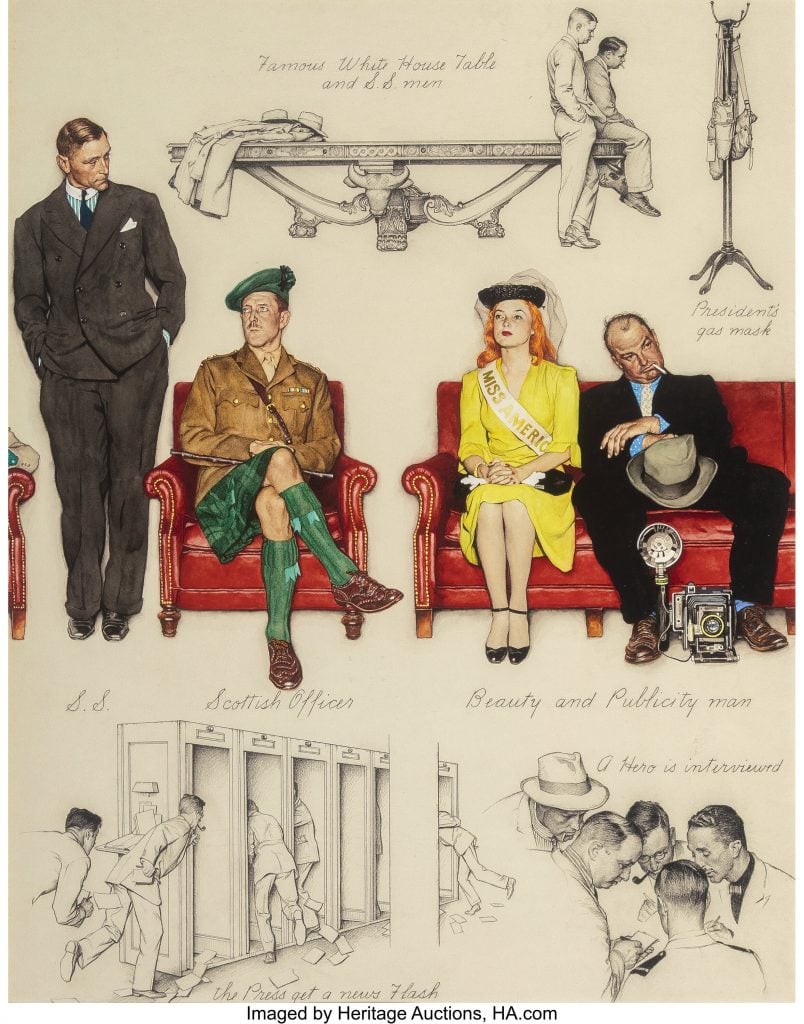
So You Want to See the President!, that's the title of the four-panel suite of paintings that, for decades, hung in the White House. Painted in 1943 by celebrated American artist Norman Rockwell, the suite portrays the waiting area outside the Oval Office, where citizens from various professions and officials gathered in hopes to meet the President. The paintings captured the democratic spirit of the era. At the height of World War II, it reflected a unifying vision of American society.

Amid the anxieties of wartime and economic uncertainty, Rockwell crafted images that evoked the nostalgia of the American Golden Age, depicting the comforts of family life and a secure home. Mainstream media often promoted this image of prosperity—which Rockwell was able to translate so well onto his canvas—to soften the realities of economic hardship and racial tension. Conservative outlets like The Saturday Evening Post used the psychology of nostalgia to soothe public unease rooted in economic vulnerability and to foster a sense of cohesion amid a racialized society. Norman Rockwell would later become a cultural icon, best known for his illustrations in The Saturday Evening Post, from the interwar years to the early decades of the Cold War.

The post-First World War period was marked by economic expansion and rapid growth, followed by a flourishing cultural environment and shifting social norms, epitomized by the emergence of the flapper counterculture. It was also a time of political progress as women finally secured the right to vote. Yet the Roaring Twenties was also a decade of economic disparity—low wages for the urban working class and persistent hardship for rural Americans—leaving many vulnerable. Not surprisingly, it was a period of continued racial tensions, marked by the resurgence of the Ku Klux Klan and the passage of the restrictive Immigration Act of 1924.

Interestingly, Rockwell’s celebrated depictions of the idealized male breadwinner nuclear family—spanning over four decades—continue to resonate with segments of the American public today.

Nevertheless, under the strict editorial direction of The Saturday Evening Post, Rockwell’s images not only masked the social tensions but also obscured the shifting norms reshaping American society. Readers were deflected from reality by scenes that told the story of a stable and harmonious American society centered on the “typical” male breadwinner and female homemaker nuclear family. Absent in these images were the independent flappers and hardly visible were the working-class, particularly women, both white and of color.

Twenty-five years later, the welfare policies and economic boom of post-World War II made the idealized male breadwinner family attainable, although very briefly, for middle-class and upper-class households. Yet this image of mainly white, suburban families, continued to be perpetuated by mainstream media for decades. It was an image that also aligned with the US government’s Cold War narrative, which promoted the nuclear family as a symbol of capitalist superiority in contrast to the collectivist ideals of communism.

Following the civil rights movement that shifted perceptions about society, new laws and policies were enacted to reduce racial and gender inequality. These reforms transformed social norms and values around family and sexuality, and shaped institutions. However, not all segments of society embraced these changes. Rockwell himself grew weary of the editorial constraints imposed by The Saturday Evening Post and, in 1963, left to work for Look magazine. There, he crafted some of his most controversial works that confronted the inequalities and tensions shaping America.

Like feminism, the far-right views women’s role in care work as undervalued by society; however, far-right supporters generally attribute this to the cultural hegemony of neoliberalism and liberal feminism.

Interestingly, Rockwell’s celebrated depictions of the idealized male breadwinner nuclear family—spanning over four decades—continue to resonate with segments of the American public today. On various digital platforms, some women from diverse ethnic backgrounds who support far-right ideologies have expressed dissatisfaction with contemporary society, describing a sense of peace and empowerment upon embracing traditional gender roles. This discontent often cites feminism for promoting a perception that privileges professional women over traditional homemakers—diminishing the cultural value of housewives and of men as primary providers and protectors.

Like feminism, the far-right views women’s role in care work as undervalued by society; however, far-right supporters generally attribute this to the cultural hegemony of neoliberalism and liberal feminism. This hegemony, in their view, has stigmatized traditional values and gender roles, where masculinity is more often loathed than encouraged and men are no longer seen as women’s protector, both in the social and economic sense. Such cultural dominance, they argue, are among the factors contributing to the decline of what they consider “true American values.”

Furthermore, the hegemony that promotes multiculturalism and diversity is perceived by far-right supporters as contributing to unresolved societal issues, such as job insecurity, limited access to public goods, and increase in crime rates, including violence against women. The increase in immigration is often cited as a cause of these problems even when such claims are not reflected in data and statistics.

The far-right movement, therefore, seeks to restore traditional “native” values as a way of deconstructing what they perceive as a broken society. However, the dissatisfaction is often attributed to shifting cultural norms, while in fact, it stems from systemic issues. The lack of accessible and trustworthy childcare, the absence of family-friendly labor policies, and the persistence of traditional gender roles that impose a double burden on women all contribute to the difficulties faced by many—particularly mothers.

Scholars interpret this as a backlash against the failure of neoliberal governance to deliver broad-based economic security and social cohesion.

Moreover, the movement asserts that saving America from perceived cultural decadence requires strengthening a monocultural national identity and reasserting national control over the economy, as economic sovereignty is framed as a moral imperative to restore traditional family values and cultural order. This vision reflects its supporters’ economic anxieties and fears of cultural displacement. Scholars interpret this as a backlash against the failure of neoliberal governance to deliver broad-based economic security and social cohesion.

Scholars have observed that neoliberal policies in the United States have deepened inequality: wages have stagnated for much of the working class, labor protections and social safety nets have eroded, and corporate profits have soared—concentrating wealth at the top. Privatization and deregulation have rendered public goods such as higher education, healthcare, and housing increasingly unaffordable. Critics of neoliberalism argue that policies prioritizing market efficiency over social equity have fueled job insecurity, housing shortages, rising rents, and racialized vulnerability. These systemic failures have contributed to cultural fragmentation, institutional distrust, and adverse political polarization.

So You Want to See the President!—which was commissioned in 1943 by Stephen T. Early, Roosevelt’s press secretary—depicted various groups in American society, conveying a unifying vision of democracy. Yet it reflects a white, middle-class lens on civic participation, mirroring the exclusionary politics and cultural norms of its time, in which structural diversity and inequality were obscured. The suite was removed from the White House in 2022 following a family ownership dispute and is scheduled for auction. While the paintings hold significant historical value, the suite’s removal is timely given that the country seriously needs to bridge political polarization. To move forward, reflection is urgently needed to envision a post-neoliberal governance that centers equity, care economies, labor protections, and democratic accountability, while dismantling structures that perpetuate marginalization and safeguard concentrated wealth.

-Some Thoughts from the Cappuccino Girl- (2025)

#history #art #WorldWar1 #WorldWar2 #US #Politics #feminism

You might be interested to read: From Global Power to Existential Anxieties: How Colonialism and Migration Shape the UK

Image: Artnet News
Sources:
Ainsworth, Garrett (2024) ‘Why Neoliberalism Has Failed Us: How Republican Economic Policies Promote Inequality.’ Michigan Journal of Economics. https://sites.lsa.umich.edu/mje/2024/03/18/why-neoliberalism-has-failed-us-how-republican-economic-policies-promote-inequality/ [8 November 2025].
Bradatan, Anastasia (2023) The Overlooked Roles of Women in Far-Right Extremist Organizations and How to Prevent Their Further Radicalization. Fordham Law Voting Rights and Democracy Project. https://fordhamdemocracyproject.com/2023/04/26/the-overlooked-roles-of-women-in-far-right-extremist-organizations [19 October 2025].
Campion, Kristy and Kiriloi M. Ingram (2023) ‘Far-right “Tradwives” See Feminism as Evil.’ Their Lifestyles Push Back Against ‘the Lie of Equality.’ The Conversation. https://theconversation.com/far-right-tradwives-see-feminism-as-evil-their-lifestyles-push-back-against-the-lie-of-equality-219000 [19 October 2025].
Cohen, Alina (2025) ‘Norman Rockwell Paintings That Once Hung in the White House Bound for Auction.’ Artnet News. https://news.artnet.com/market/norman-rockwell-president-white-house-paintings-auction-2704973 [4 November 2025].
Joppke, Christian (2024) ‘Neoliberal Nationalism and Immigration Policy.’ Journal of Ethnic and Migration Studies. https://www.tandfonline.com/doi/pdf/10.1080/1369183X.2024.2315349 [8 November 2025].
Leidig, Eviane (2021) “We Are Worth Fighting for”: Women in Far-Right Extremism. International Centre for Counter-Terrorism – ICCT. https://icct.nl/publication/we-are-worth-fighting-women-far-right-extremism [19 October 2025].
Shams, Shahrzad, Deepak Bhargava, and Harry W. Hanbury (2024) ‘The Cultural Contradictions of Neoliberalism: The Longing for an Alternative Order and the Future of Multiracial Democracy in an Age of Authoritarianism.’ The Roosevelt Institute. https://rooseveltinstitute.org [8 November 2025].
Stiglitz, Joseph (2024) ‘How Neoliberalism Failed, and What a Better Society Could Look Like.’ Working Paper. Roosevelt Institute. https://rooseveltinstitute.org [8 November 2025].
Williams, Katherine (2024) Women's Engagement with the Far Right: A Quest for a More Holistic Understanding. Compass Hub. https://compass.onlinelibrary.wiley.com/doi/10.1111/rec3.12495 [19 October 2025].
Zamora, Daniel and Niklas Olsen (2019) How Decades of Neoliberalism Led to the Era of Right-Wing Populism. Jacobin.com. https://jacobin.com/2019/09/in-the-ruins-of-neoliberalism-wendy-brown [8 November 2025].

POPULAR TOPICS #subculture Gurlesque: Poetics of the Bizarre, Ugly, and Feminine #films Mrs. Robinson, Countercultures, and Politics #history The Dutch Golden Age, Golden for Whom? I also write articles here: https://feministpassion.blogspot.com/

Love and geopolitics often intertwine in heartbreaking and unforgettable narratives, whether legend, fiction, or real-life accounts. These stories are typically entangled in ethnic and religious conflict, ideological divide, and forbidden romance framed by identity politics—elements that render resolution unforeseeable.

Love Is Forbidden

Some true love stories are carved into time through poetry and become not only the legacy of a people but also a defining part of their history. One such story is the love affair between the late renowned Palestinian poet Mahmoud Darwish (13 March, 1941—9 August, 2008) and the Jewish-Israeli young woman he fell deeply in love with in the early 1960s. A woman whom he refers to as “Rita” in his poems—a name that echoes across two decades of his artistic career, shaped by imprisonment, political estrangement, and exile.

In his 1969 poem Rita… Love me, Darwish reflects on the impossibility of their love:

Love is forbidden… Here the police and fate are antiquated Shattered are the idols that you revealed your love

Another passage from the same poem expresses the pain of loss:

Sleep on my dream. Your taste is acrid Your eyes are lost in my silence And your body is full of summer and beautiful death. At the end of the world I embrace you When you withdraw full of the impossible.

Their forbidden love could not survive the political tension it was engulfed in, especially after “Rita”, whose real name is Tamar Ben-Ami, joined the Israeli army—a decision which ended their romance. Nevertheless, intimate love letters Darwish wrote to her in Hebrew—kept secret for decades and later revealed in the documentary, Write Down, I am an Arab (2014)—stands as a testament to how love, ruptured by political and ideological divide, is silently endured.

This silenced love is reflected in the famed 1966 poem, Rita and the Rifle, where Darwish writes:

Oh, the silence of dusk In the morning my moon migrated to a far place Towards those honey-colored eyes And the city swept away all the singers And Rita. Between Rita and my eyes— A rifle.

The death of the romance, plagued by political violence and civil surveillance, impacted Darwish’s art. The love he held for “Rita” remains alive through his poetry, echoing across generations.

Betrayal and Forgiveness

Betrayal potentially arises in a love affair entangled in geopolitics and ideology. One such case is the well-known affair between German-American philosopher Hannah Arendt (October 14, 1906–December 4, 1975) and her professor, the influential yet controversial German thinker Martin Heidegger (September 26, 1889– May 26, 1976). Arendt first met Heidegger in late 1924 as an 18-year-old student at the University of Marburg. Their encounter subsequently sparked a relationship that would last several years—kept discreet due to Heidegger’s marriage. Yet what ultimately shadowed their bond was Heidegger’s later affiliation with the Nazi party, a betrayal that would affect both their personal connection and Arendt’s ethical reflections for decades.

It was only after their love letters were discovered in the 1980s and published that the relationship between Hannah Arendt and Martin Heidegger became publicly known, igniting intense scholarly debate. The controversy centered on Heidegger’s affiliation with the Nazi Party, which he joined in 1933—just as Arendt, a Jew, was fleeing Germany following a brief detainment by the Gestapo.

In his first letter to Arendt, written in February 1925, Heidegger confesses:

“I will never be able to call you mine, but from now on you will belong in my life, and it shall grow with you.”

A year later, Arendt had broken off the relationship with Heidegger following her move to the University of Heidelberg. However, they continued to correspond into the early 1930s. In April of 1928, a letter from Arendt reflects the depth of their enduring love:

“I love you as I did on the first day—you know that, and I have always known it, even before this reunion. The path you showed me is longer and more difficult than I thought.”

In 1929, on her wedding day, Arendt writes:

“Do not forget me, and do not forget how much and how deeply I know that our love has become the blessing of my life. This knowledge cannot be shaken, not even today ...”

She closes the letter affectionately:

“I kiss your brow and your eyes, Your Hannah”

After a long silence—likely prompted by Heidegger’s Nazi affiliation—Arendt, now in her second marriage, chose to reconcile with him in 1950, not as a romantic partner, but as an intellectual peer. This decision was triggered by their first reunion in Freiburg that same year. The posthumous publication of their postwar letters later revealed the depth and complexity of this renewed connection, leading many scholars to reexamine how Heidegger’s influence and their relationship shaped Arendt’s thought, as Adrent is considered one of the most influential political theorists of the twentieth century.

In The Human Condition (1958), Arendt introduces the concept of natality—the capacity for new beginnings. For her, human freedom is rooted in the ability to initiate anew, even in the wake of betrayal and historical trauma. Natality enables reconciliation not by erasing the past, but by narrating and accepting it, and by exercising judgment toward both past and future.

While reconciliation has its limits—especially in cases of crimes where justice demands accountability—Arendt viewed both reconciliation and nonreconciliation as acts of political judgment. Both are judgments of the past and future and thought and action. These judgments, which require one to think from the standpoint of everyone else and reflect beyond ideological divisions, open the possibility for forgiveness and reconciliation. This framework may illuminate Arendt’s postwar reconciliation with Heidegger, which unfolded through a series of affectionate and intellectually vibrant correspondences between the two philosophers.

Furthermore, Arendt envisioned a shared world of plurality, where difference and equality coexist—not a nation-state founded on ethnic exclusivity. This vision was likely shaped by her lived experience: years spent in exile as a Jew, and her conflicted yet compassionate relationship with Heidegger.

Historical Trauma: Beginning Anew

Even in the face of political oppression and ideological division, love can flourish—persisting between those on opposing sides. Darwish and Tamar’s relationship demonstrates that, in such circumstances, loving “the Other” becomes a political act. His poems have become part of Palestine’s collective memory, shaping how a people remember their past and imagine their future—how they perceive and respond to historical trauma.

In Arendt’s perspective—shaped by her lived experience—historical trauma should not justify vengeance, but rather open a path toward beginning anew: to acknowledge irreversible loss and envision the future. This suggests that even in the face of devastation, forgiveness and reconciliation are key to peace-building—actions that enable coexistence grounded in plurality, dignity, and equality within and across nations. On the ground, this entails a journey of judgment that ensures the meaningful representation of survivors and marginalized groups—including women, though Arendt does not explicitly address gender—in the processes of truth-telling, testimony, inclusive dialogue, and the honoring of collective memory. Could Arendt’s vision help address today’s atrocities?

-Some Thoughts from the Cappuccino Girl- (2025)

#history #literature #ideology #politics #Palestine #Germany #WorldWar2 #films #fascism

You might be interested to read: The Salute of Tyranny

Images: Darwish via arablit.org; Arendt by Fred Stein via deutschland.de
Sources:
Berkowitz, Roger (2017) ‘1. Reconciling Oneself to the Impossibility of Reconciliation: Judgment and Worldliness in Hannah Arendt’s Politics.’ In Roger Berkowitz and I. Storey (eds.) Artifacts of Thinking: Reading Hannah Arendt's Denktagebuch. New York, USA: Fordham University Press. https://doi.org/10.1515/9780823272204-002.
McMahan, Luke (2024) ‘Rita… Love Me: A Poem by Mahmoud Darwish’, Arab America. https://www.arabamerica.com/rita-love-me-a-poem-by-mahmoud-darwish [8 August 2025].
Murray, Eóin (2008) ‘Obligations of Love, Obligations of Politics’, Poetry Ireland. https://www.poetryireland.ie/writers/articles/obligations-of-love-obligations-of-politics [10 August 2025].
Poem Hunter (2013) Rita and the Rifle—Poem by Mahmoud Darwish https://www.poemhunter.com/poem/rita-and-the-rifle/ [8 August 2025].
Popova, Maria (2016) ‘The Remarkable Love Letters of Hannah Arendt and Martin Heidegger’, The Marginalian. https://www.themarginalian.org/2016/04/25/hannah-arendt-martin-heidegger-love-letters [8 August 2025].
Puspapertiwi, Erwina Rachmi and Sari Hardiyanto (2023) ‘Kisah Mahmoud Darwish, Penyair Palestina yang Jatuh Cinta pada Perempuan Yahudi.’ Kompas.com. https://www.kompas.com/tren/read/2023/12/08/133000065/kisah-mahmoud-darwish-penyair-palestina-yang-jatuh-cinta-pada-perempuan?page=all#page2 [8 August 2025].
Wasserstein, David J. (2012) ‘Prince of Poets’, The American Scholar. https://theamericanscholar.org/prince-of-poets [10 August 2025].

POPULAR TOPICS #subculture Gurlesque: Poetics of the Bizarre, Ugly, and Feminine #films Mrs. Robinson, Countercultures, and Politics #history The Dutch Golden Age, Golden for Whom? I also write articles here: https://feministpassion.blogspot.com/

Early in the morning of the special day, the noise and bustle of families getting ready echo through the open windows of the building. Quickly, Antonietta pours the coffee already waiting on the stove, brings the filled cup to the table—between the uniforms she had just ironed—to add some sugar. Now with cup, saucer, and teaspoon in her left hand and uniforms draping on the arm, she walks to each bed to wake the kids one by one. While taking small sips of coffee from the spoon, she hands each child their uniform. Finally reaching the last bed—the sixth and biggest—she wakes her husband and hands him the coffee. The rounds are not over yet. Next to Papa, buried under the covers, is their youngest!

This is the special day, all of Rome are getting ready for the parade. Not Antonietta, however, even though she is a big supporter of Il Duce. Her wifely duties do not allow her the luxury to spend a whole day out of the house, unlike women who have domestic helpers. Antonietta will miss the historical moment Il Duce welcomes German fascist leader, Adolf Hitler, on his seven-day visit to Italy.

Hitler’s visit to Italy on May 3rd, 1938 was a significant moment in the history of fascism. Despite the fanfare, Mussolini or Il Duce, as he was called, did not agree to a military alliance with Germany. Nonetheless, after this visit, Mussolini began introducing laws which marginalized Italy’s Jewish people.

Having stayed home, on that special day Antonietta experienced a life changing moment. Whilst trying to catch her escaped bird, it was when she by chance met her neighbor, Gabriele, who lived across her apartment building. The bird had flown near Gabriele’s window while he was at his desk, contemplating suicide. After an exchange of visits on that day, she learned that Gabriele was a radio broadcaster who was fired and will be deported to Sardinia. His crime: being gay. Unlikely as it may seem, the two instantly connected. They both learned of each other’s life and their different views of the government, and as the story unfolds, the odd couple fell in love.

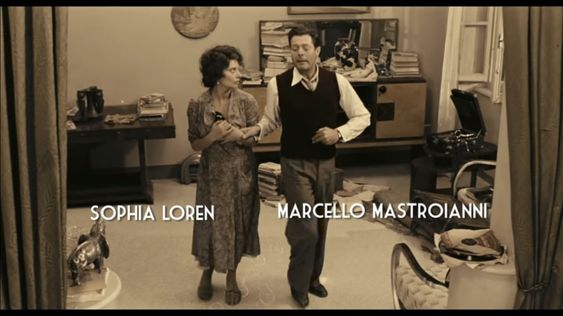
This is the storyline of the critically acclaimed Italian film A Special Day, directed by Ettore Scola and produced by Carlo Ponti. Released in May 1977, starring Sophia Loren and Marcello Mastroianni, the film received many awards, including the César Award, Golden Globe Film, and Nastro d'Argento, in addition to two Academy Award nominations. Interestingly, Mussolini’s granddaughter, Alessandra Mussolini was cast in the film.

Through the events of one day, the film gives a daunting picture of life under fascism. The omnipresence of the ruler in daily life is interwoven into the narrative and through the background sound of the parade taking place.

The story revolves around Antonietta (Sophia Loren), a low-educated, lower middle-class housewife. She is the image of the ideal Italian woman under fascism—an admirer of Il Duce, a devoted housewife and mother; a devotion extended to the state. “I have six children”, Antonietta said as she introduced herself to Gabriele (Marcello Mastroianni). “By the seventh, they will give you a bonus.”

The government gave prizes and compensations to encourage women to bear many children with the aim of increasing the Italian population and army reserve. Single men, like Gabriele, in contrast, were taxed.

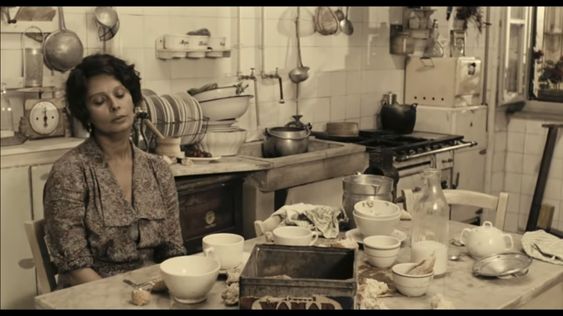
Antonietta’s husband (John Vernon) is the typical Italian fascist male of the time—the breadwinner and savior who treats his wife like an inferior being and has affairs with other women. Nevertheless, like the beloved Italian woman of the time, her family and the kitchen are the center of Antonietta’s life. From the kitchen table she would gaze out the window while pouring the remains from other cups into her cup—never really having her own cup (or life), except during Gabriele’s visit. Il Duce is present in family life through his picture that overlooks the kitchen. How the occupants are able to see each other through the windows is an extension of state surveillance.

“You forgot to take this,” said Gabriele, who suddenly appeared at Antonietta’s door, holding The Three Musketeers, the book which he had recommended earlier to Antonietta. He ended up coming inside and grinding coffee beans (and spilling some on the floor) for the cup of coffee Antonietta had offered. Then came a knock on the door. The caretaker (Françoise Berd) had come to warn Antonietta about Gabriele, who she knew was visiting Antonietta.

However, Antonietta was smitten by Gabriele, a liberal, antifascist, and gay radio broadcaster on the verge of suicide.

However, Antonietta was smitten by Gabriele, a liberal, antifascist, and gay radio broadcaster on the verge of suicide. How they made love, considering Gabriele’s sexual orientation, is open to interpretation—except for the conclusion that Antonietta had changed him. In fact, it was Antonietta who was changed by this encounter as she now sees fascism in a different light.

The film, however, did not fully capture the public life of Italian women under fascism. Although confined to domesticity, thousands to millions of women were enrolled in government-created women’s organizations.

In line with the state’s gender ideology, many women’s organizations focus on maternal health issues and care for newborns. However, these organizations were not merely a campaign to mobilize female supporters. They served an important purpose in reducing Italy’s high infant mortality rate, which was at 106.2 deaths for every 1,000 lives in 1938—the highest in Europe. Mussolini believed that a rapid increase in the Italian population could be achieved by banning contraception, illegalizing abortion, and establishing mass women’s organizations, where women worked to assist other women to improve hygiene, health, and nutrition.

From this view, fascist policies which excluded women did not completely isolate women from society.

From this view, fascist policies which excluded women did not completely isolate women from society. Women, in fact, had an important social role within the fascist framework, whilst any role was absent in the previous liberal state. Although these organizations controlled and limited women’s role as reproductive machines, in their own way, they empowered women. It was the first time any assistance of the kind, which improved women’s knowledge and skills about health and maternity, included women of all levels of the society. Nevertheless, the effectiveness of these organizations is debatable and despite a nationwide propaganda to promote the nobleness of motherhood, the population did not significantly increase and many women continued to work because of necessity.

All in all, A Special Day depicts how fascism penetrated into the private sphere, controlled and oppressed the individual, as reflected in the lives of Antonietta and Gabriele. She was treated as the chattel in the battle for population; he, the male degenerate.

In the evening of the special day, the authorities came for Gabriele. While gathering his things, he accidentally found a few coffee beans in the pocket of his suit. Slightly bewildered, he took a quick glance across the window. Minutes later, from her window, Antonietta watched as Gabriele leaves in the night escorted by two men. She was reading aloud the first few pages of The Three Musketeers—the political tale he left her with.

-Some Thoughts from the Cappuccino Girl- (2023)

#films #cinema #Italy #fascism #history #gender #worldwar2

Read about modern political strongmen: Political Strongmen and the Crisis of Democracy

If you are interested in how population polices affect women, read: Only Women Breed: Population Policies and Gender

Images: Cult Film trailers: https://youtu.be/KloWrqcHAF0
Sources:
Cavendish, Richard (2008) ‘Hitler and Mussolini Meet in Rome.’ Historytoday https://www.historytoday.com/archive/hitler-and-mussolini-meet-rome (Accessed 22 January 2023).
Monti, Jennifer Linda (2011) The Contrasting Image of Italian Women under Fascism in the 1930’s. Syracuse University Honors Program Capstone Projects. 714. https://surface.syr.edu/cgi/viewcontent.cgi?article=1706&context=honors_capstone (Accessed 26 December 2022).

POPULAR TOPICS #subculture Gurlesque: Poetics of the Bizarre, Ugly, and Feminine #films Mrs. Robinson, Countercultures, and Politics #history The Dutch Golden Age, Golden for Whom? I also write articles here: https://feministpassion.blogspot.com/
The nineteenth to twentieth century in western Europe was a period when the intellectual community and the cultural and art movements flourished. Austria, particularly Vienna, and the Weimar Republic, particularly Berlin, were the centers of these cultural movements where the salon and coffeehouse culture grew. During this period, women enjoyed inclusion in some areas of the public sphere, while economic and political discrimination prevails. The wars, power struggles, and economic and political instabilities all played a role in women’s changing position in society at the onset of fascism.

Vienna, the multicultural city of immigrants in the 19th century, was famous for its European salon culture. Conceived by the middle and upper classes, the salons provided the medium for intellectual discussion and critical thinking. Moreover, the salons provided a space for the integration of the Jewish immigrants into society's elites. The salon culture was also a means of acculturation and emancipation for Jewish women. In Vienna and Berlin, many of these salons were hosted by educated Jewish women. The salon culture, however, was soon replaced by the more accessible and popular coffeehouse culture.

In 19th century Vienna and Berlin, coffeehouses became a meeting place for people from diverse backgrounds, including the less wealthy, and served as a place for intellectuals to exchange ideas and hold discussions. The coffeehouse culture was closely associated with the Jewish intellectual and artistic community. However, coffeehouses excluded women, supporting the conservative gender ideology of the time.

The coffeehouses grew to become an important part of Viennese multicultural urban life. Viennese coffeehouses gave birth to a new generation of movements, such as the Young Vienna modernist literary movement which was spearheaded by male Jewish intellectuals. Vienna’s intellectual community thrived to influence ideas which developed throughout Europe.

Nonetheless the inevitable was to come. The influx of immigrants crowded the city and affected the workforce, turning Vienna into a breeding ground for conservatism, nationalism, and anti-Semitism. In the last decade of the century up to 1914—known as the “Fin-de-Siècle” or turn of the century—the coffeehouse culture faced the challenge of rising anti-Semitism, while the salons continued to decline due to prevalent misogyny and antifeminism.

The golden age of liberalism ended in 1895 when conservative powers took over. This was followed by a weakening middle class and the quite death of the salons. The coffeehouse intellectuals who played an important role in the advancement of liberalism were fighting a losing battle.

Politics took another turn after the First World War. A strong labor and feminist movement grew out of the postwar crisis in Vienna and had set the motion for radical changes in policies which favored the working class, including the women. “Red Vienna”, home to migrant laborers from across the empire, became the haven for workers’ power.

Unsuspectedly too, the Great War was like a blessing in disguise for the women of the Weimar Republic (Germany in 1918–1933). Before the war, Germany was a constitutional monarchy with a parliament elected by adult males. After the war, with the removal of the Kaiser, Germany became a republic with representative democracy. Women were given political and economic rights. Besides gaining the right to vote, women were also granted equality in marriage and the professions.

The new independent woman of the Weimar Republic was coined the “New Woman” and she became the icon of the republic’s golden liberal era and the face of popular media. After women had a taste of economic independence when working during wartime to replace men, many continued to work and enjoyed an active social life. Women were able to do what was unthinkable just a few years before: enjoy the single life, smoke, drink, drive a car, and dance in jazz clubs. The coffeehouses were no longer a male domain as it were before the war; women were free to roam the coffeehouses unchaperoned. In Berlin, the center of Weimar culture, well-known Jewish women writers and artists were regulars at coffeehouses, such as the Romanisch Café.

However, unlike the image of the New Woman and its café lifestyle—which was sexualized and exploited by the media—in reality, women continued to face economic and political discrimination under Weimar liberalism. After supporting the workforce in wartime, the majority of working women became menial workers with the re-employment of men and then used as cheap labor. Meanwhile, in politics, women only had access to areas related to the home and family, such as health, education, and religion.

So, when politics took a different turn and the Nazis came to power—they, although rather ironically, had the blessings of the Weimar women. War reparations, hyperinflation, the collapse of the economy in 1923, and the Depression that followed had the republic on its knees. The economic crisis and a weakened government paved the way for the fascist party, which many, including the Weimar women, saw as offering the only hope for rebuilding the country. With no real political role to play, Weimar women leaders looked to Hitler to secure their political positions and thus gave their support to the Nazi party. Unfortunately, this was poor judgement.

Weimar’s fall in 1933 was followed by Red Vienna succumbing to the economic and political pressure of the conservative federal state in 1934. The end of the Weimar Republic and the annexation of Austria by Nazi Germany in 1938 saw an exodus of the Jewish population which had played an important role in the development of both countries. Subsequently, women were reduced to their reproductive role under fascist ideology. The crises and weakened regimes provided fascism with the means to rise to power by convincing many that it will transcend liberalism, democracy, and socialism.

-Some Thoughts from the Cappuccino Girl- (2022)

Image: Painting by German artist Jeanne Mammen, 1927

#Vienna #Austria #Weimar #Germany #salonculture #coffeehouseculture #women #gender #fascism #politics #history #worldwar1 #worldwar2 #Europe

I have written about the above topics before, if you're interested, read:

More about Vienna and its coffeehouse culture: https://feministpassion.blogspot.com/2018/05/turn-of-century-vienna-liberalism.html

More about the Weimar New Woman: https://feministpassion.blogspot.com/2020/04/from-weimar-new-woman-to-mother-of.html

Sources
BBC Bitesize (2022) The Growth of Democracy in Germany, 1890-1929. https://www.bbc.co.uk/bitesize/guides/zcwxrdm/revision/2. (Accessed 29 January 2022).
Buzynski, Isabella and Kai Mishuris (2014) ‘Jewish Café Culture in Berlin.’ ArcGIS StoryMaps. https://storymaps.arcgis.com/stories/73fce8a685b64bb29fe87715bf72dc12 (Accessed 29 January 2022).
Galerie St. Etienne (2006) More Than Coffee was Served, Café Culture in Fin-de-Siècle Vienna and Weimar Germany. https://www.gseart.com/exhibitions-essay/1016 (Accessed 30 January 2022).
Mann, Michael (2004) 'The Rise and Fall of Fascism.' UCLA Book Reviews. https://escholarship.org/uc/item/9pg469w2 (Accessed 30 January 2022).
Schirn.de (2017) Splendor and Misery in the Weimar Republic. http://www.schirn.de/glanzundelend/digitorial/en (Accessed 30 January 2022).
Wilhelmy-Dollinger, Petra (1999) ‘Berlin Salons: Late Eighteenth to Early Twentieth Century.’ Shalvi/Hyman Encyclopedia of Jewish Women. Jewish Women's Archive. https://jwa.org/encyclopedia/article/berlin-salons-late-eighteenth-to-early-twentieth-century. (Accessed 30 January 2022).

POPULAR TOPICS #subculture Gurlesque: Poetics of the Bizarre, Ugly, and Feminine #films Mrs. Robinson, Countercultures, and Politics #history The Dutch Golden Age, Golden for Whom? I also write articles here: https://feministpassion.blogspot.com/
“Mrs. Robinson, you’re trying to seduce me.” That is one of the most famous lines from Hollywood’s classic, The Graduate (1967). Through Benjamin’s (Dustin Hoffman) relationship with Mrs. Robinson (Anne Bancroft)—a young fresh graduate with a bored middle-aged, middle-class housewife turned seductress—the movie tells a story of a noteworthy period in American history.

Following the postwar economic boom and increase in population, in the 1950s young middle-class couples moved from the overcrowded cities to new housing areas in the suburbs. These homes, equipped with new efficient home appliances, particularly in their kitchen design, were dubbed the “typical American house”. In 1959, Nixon once tried to enlighten Soviet leader, Nikita Khrushchev about the dishwashers directly installed in these houses. Nixon claims, “In America, we like to make life easier for women.”

It was during this Cold War period that the ideal white middle-class American family consisting of children, a male breadwinner and housewife was part of a political propaganda. In the US Cold War propaganda abroad, gender ideology played an important role to establish capitalism’s success over communism through the image of the Western middle-class, breadwinner-housewife nuclear family.

In fact, in the 1950s, the term middle-class Americans was more of a political term rather than an economic term, as political scholars have pointed out. The term was used to refer to an American identity associated with a set of values, a specific lifestyle, taste, and culture. This was marked by the rise of a consumer culture and a culture of conformity. It was against this setting that counterculture movements began to emerge.

The counterculture movements criticized the establishment, class divisions, education, gender norms, as well as the family and marriage institutions. The movements' dissatisfaction with American society is reflected in The Graduate through Ben’s journey to leave his dull privileged-life and break free from society’s conventions.

The story line reflected the hypocrisy of the privileged life in the comfortable suburban homes, which confined women to domesticity. In her research published in her book The Feminine Mystique (1963), Betty Friedan revealed that behind the doors of many seemingly happy suburban homes, lived an unhappy educated housewife who was discontent with domestic life. As much as the counterculture movements, such as the Beat and hippie movements, appear to offer a kind of sexual revolution—women—as disclosed in Beat women’s memoirs, remained as sexual objects and domestic creatures.

It was not only traditional values that encouraged women to primary be domestic beings, but it was also the politics of the day. For example, political issues surrounding childcare in the US had a significant contribution to the domesticity of women. During the Second World War, women were mobilized to work due to the urgent need of fulfilling war production. To encourage and enable women to join the workforce, the government provided quality federal-funded daycare. When the war ended and women were expected to return home to make way for male employment, the daycare initiative ended, despite considerable opposition from many women.

When the need for federal-funded collective childcare was raised again in the 1960s and ‘70s, it continued to face objection, in part, because the Cold War foes use such a system, so it was deemed incompatible with American values. Nixon vetoed the Comprehensive Child Development Act of 1971 arguing that it would “commit the vast moral authority of the National Government to the side of communal approaches to child rearing over against the family-centered approach.” Thus, childcare was and is still treated as an issue for individual families—particularly the women—to cope with, rather than an economic investment that will empower women and their families. Not surprisingly, to date, the US has no adequate childcare infrastructure intact, a problem which has been further exacerbated by the pandemic.

However, as with the politics of the Cold War era, male-dominated countercultures which emerged at the time too did not want to deal with any issues that might disrupt the gender power structure too much at their inconvenience. In terms of gender equality, changes were slow. As we see, after Mrs. Robinson’s liaison with Ben, she comes back to the comfort of her suburban home, behind the doors of the domesticity that define her.

-Some Thoughts from the Cappuccino Girl- (2021)

#ColdWar #counterculture #US #childcare #WorldWar2 #gender #history #literature #films #cinema #class

More on The Graduate https://feministpassion.blogspot.com/2021/11/the-graduate-and-middleman.html More on US wartime childcare https://feministpassion.blogspot.com/2021/09/war-politics-and-childcare-in-us.html More on countercultures https://feministpassion.blogspot.com/2017/07/flapper-queens-beats-mods-and-punk.html

Sources
Dratch, Howard (1974). The Politics of Child Care in the 1940s. Science & Society, 38(2): 167–204. http://www.jstor.org/stable/40401779 (Accessed 25 July 2021).
Friedan, Betty (1973) ‘Up from the Kitchen Floor.’ NY Times. https://www.nytimes.com/1973/03/04/archives/up-from-the-kitchen-floor-kitchen-floor.html (Accessed August 22, 2020).
Krasner, Barbara (2014) ‘The Nuclear Family and Cold War Culture of the 1950s.’ Academia. https://www.academia.edu/9926751/The_Nuclear_Family_and_Cold_War_Culture_of_the_1950s (Accessed December 21, 2019).
Maragou, Helena (2015) Lawrence R. Samuel, The American Middle Class: A Cultural History. Review https://journals.openedition.org/ejas/10458 (Accessed 14 November 2021).
Punch, David A. (2018) The Graduate: Symbolism in Film. https://medium.com/@DavidA.Punch/the-graduate-symbolism-in-film-a549ef9882c0 (Accessed 21 November 2021).
The Kitchen Debate-transcript 24 July 959 Vice President Richard Nixon and Soviet Premier Nikita Khrushchev U.S. Embassy, Moscow, Soviet Union. https://www.cia.gov/library/readingroom/docs/1959-07-24.pdf (Accessed August 16, 2020).

POPULAR TOPICS #subculture Gurlesque: Poetics of the Bizarre, Ugly, and Feminine #films Mrs. Robinson, Countercultures, and Politics #history The Dutch Golden Age, Golden for Whom? I also write articles here: https://feministpassion.blogspot.com/

“Calling to arms all men from 21 to 55 years old, Italy can mobilize 8,000,000 men, and adding young men of 18, 19, and 20 years more than 9,000,000 ….”

The nation’s leader, Benito Mussolini—or better known as II Duce to his people—did not fail to cast a spell on the cheering crowd on the 30th of March 1938. His speech continued to spark the crowd as he shouted,

“This shows how ridiculous are the polemics of certain circles beyond the Alps according to which the African war, the formation of two army corps in Libya and the participation of volunteers in the Spanish war have weakened us.

On the contrary, all that strengthened us …”

In fascist Italy, the modern Italian man is what makes up the nation—he is the nation, the nation is him. War was no longer seen as misery, but an honor. It was a time of great hope and pride as II Duce attempted to revive the glory of the Roman Empire. The men were the soldiers; the women were mothers who earned medals for supplying the nation with its soldiers and workers.

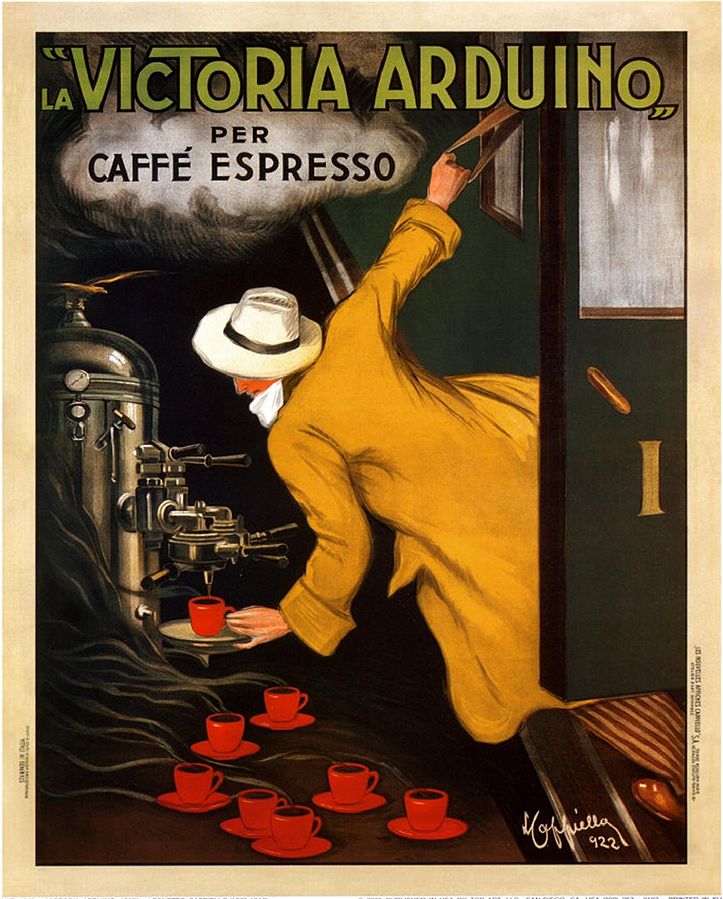
The fascist regime promoted espresso to the workers. In the morning, workers line up against the counters of espresso bars, sipping their cups only for minutes, before dashing off to work for the nation. The new steam espresso machine makes coffee fast like a speeding steam train, but just cool enough to immediately drink. In only seconds the espresso will flow smoothly from the machine like a long mouse tail into the small cups, an analogy with the steam trains, which in a split second, will arrive at the stations as scheduled. Even though the promptness of the trains was false, both the train and the espresso machine served as Mussolini’s propaganda to demonstrate the technological advancement, industrialization, and modernization of what was once a war-torn Italy.

The nation was trying to rise from its knees by the lift of a strongman as the memory of the First World War had slowly dwindled but not forgotten. For Mussolini, founder of Italy’s National Fascist Party—the Italian espresso was the nation’s drink, that of a modern Italy. For the nation’s strongman, it was political as much as cultural.

Looking back, who would have thought that the strongman, who vowed to lift Italy from the trenches, would be executed in humiliation as he was by the people of his country? On April 28, 1945, Mussolini was captured while trying to flee with his mistress.

The empire Mussolini aspired to build did not, by far, have the military skills of the Romans. The dictator who was responsible for the war losses and death of his people had left his wife of three decades and their children to escape and save himself.

Even more humiliating was what happened after his death. On April 29th, 1945, the bodies of II Duce and his mistress, Clara Petacci, and three supporters who were executed along with them, were hanged upside down at the town square of Milan to satisfy the angry mob. This event is what is best remembered of the strongman who fell from grace.

Nonetheless, the Italian espresso and the coffee bars that Mussolini used in his fascist propaganda were quickly disassociated with the strongman. The Italian espresso culture lived on to be celebrated around the world.

-Some Thoughts from the Cappuccino Girl- (2021)

#fascism #WorldWar1 #WorldWar2 #Italy #Espresso #history

Note: Mussolini’s speech is quoted from: http://bibliotecafascista.blogspot.com/2012/03/speech-in-senate-march-30-1938.html.

I first wrote this piece as a historical fiction short story, although it may have not turned out too well. In case you are interested, you can read it here: The Strongman's Espresso https://feministpassion.blogspot.com/2021/06/the-strongmans-espresso.html.

POPULAR TOPICS #subculture Gurlesque: Poetics of the Bizarre, Ugly, and Feminine #films Mrs. Robinson, Countercultures, and Politics #history The Dutch Golden Age, Golden for Whom? I also write articles here: https://feministpassion.blogspot.com/

Coffee has always had the magic to draw people together and chat. For some autocratic rulers, this is a recipe for political unrest. So for reasons related to rulers’ anxiety, coffee was banned in Mecca in 1511, Cairo in 1532, Constantinople in 1623, and Prussia in 1777, and was almost banned in England in 1675.

On the contrary, Mussolini, who founded Italy’s National Fascist Party in November 9th 1921, was not afraid of a coffeehouse full of men. In fact, coffee bars and espresso were an important part of Mussolini’s state propaganda to build a national identity. Mussolini replaced the English word “barman” with “barista” to certify the Italian coffee culture. Espresso bars with the modern technology of espresso machines represented the “modern Italian man”, just like a quick cup of espresso: vigorous and on the go.

Fascism of course relies on cultural unity, but equally important is the making of a national economic vanguard. Mussolini found the latter in Italy’s domestically produced aluminum which was set to lead the national economy. Interestingly, this idea went hand in hand with the idea of espresso representing Italy’s national drink. In 1933, Alfonso Bialetti invented the first celebrated stovetop “Moka Express” espresso maker using guess what? Aluminum! (Read more in Jeffrey T. Schnapp, ‘The Romance of Caffeine and Aluminum’, 2001).

Interestingly too, while for fascist Italy coffee resonated with the idea of strong, dynamic, and energetic men, its ally, Germany had a completely different view of coffee. Under Nazi rule, caffeine was viewed as a stimulant that would poison the pure Aryan flesh. But the German people could still enjoy that ah… irresistible taste of fresh brewed coffee. Decaffeinated coffee, invented by Ludwig Roselius in Bremen in 1905, was widely popular in 1930s Germany. Would you have guessed this link between decaf and fascism? But that’s a story we will have to discuss another time.

Back to Italy. Apparently, the aluminum Moka Express didn’t take off that well during war time. In part, this was due to limited production and marketing. It was not until post-World War II when Bialetti’s son launched a nation-wide marketing campaign and increased the production of the Moka Express, that it finally became a household name. Along with the fall of fascism, changes in postwar Italy’s family values and gender roles encouraged the acceptance of this home appliance. This changed espresso from being a drink associated with the male-dominated public domain to a common drink in the private domain. Made in the comfort of the kitchen, a cup of espresso is now a family affair. Nothing like politics and a good cup of Italian espresso!

-Some Thoughts from the Cappuccino Girl- (2019)

#coffee #espresso #Italy #fascism #worldwar2 #history

POPULAR TOPICS #subculture Gurlesque: Poetics of the Bizarre, Ugly, and Feminine #films Mrs. Robinson, Countercultures, and Politics #history The Dutch Golden Age, Golden for Whom? I also write articles here: https://feministpassion.blogspot.com/