I don't really understand how to learn music. Or arts in general. Because I am a linguistics researcher I know how people learn languages (you don't really “learn” them), and I understand how people learn things like math or sociology, which is completely unlike language. But music is a bit like language and a bit like math. I'm having a lot of fun with musicology (the equivalent of linguistics, as opposed to language learning); but just like studying grammar is an entirely different skill and wholly unrelated to the process of becoming fluent in a language, or just like researching sports science is a different skillset and unrelated to becoming good at playing a sport, so also analysing the structure of music is an entirely different skill than actually being able to produce it. I understand how the former is done, but the latter? It baffles me.
Shinobue books will often have titles like “The joy of shinobue” or “Gentle shinobue for everybody”. Then there's the reverse psychology way of appealing to customers: Toki Tatara's Oni-ren (“demon training”) drills carry the implication that if you survive these intense exercises from hell, your skill level will go up. But does either rationale necessarily follow?
The shinobue is a very simple instrument used for folk music, not meant as something transcendent or intellectual like the shakuhachi or ryūteki. The other day I got the 5€ booklet Yamada Kaishi and Fukuhara Kan, distributed by Suzuki along with plastic instruments, often intended for children.
I was surprised to find, already at this level, a discussion of how the cross-fingering known as 0—nominally the same as a flattened 7—is actually not exactly the same pitch as 7♭, and that the difference should be used mindfully for emotional expression. Moreover the nuances are specifically noted as relevant for what I've been obsessing with for over a year, which is to play a good rendition of Sakura, Sakura in particular.
It's well-known by now that this haunting tune uses the uniquely crunchy Bulgarian style of folk choir, which leverages to great effect the “dissonant” intervals avoided by classical choirs (see this analysis by Wym). Japanese folk music doesn't really do harmony,¹ so the basic recipe here was to write a premodern Japanese-style song, then blend it with Bulgarian-style chanting. But—which “Japanese style”? Ohayashi? Jiuta? Joruri? Enka?
I understand how instruments are classified by the mechanisms they use to generate sounds, which influences the timbre. But in my mind I tend to think of the winds by how you, the performer, get the damn thing to make a sound.
Some of my audience may not be familiar with arthouse movies. There's a tradition in cinema that doesn't follow the conventions set by Hollywood, or other big-budget productions like Bollywood or Hong Hong cinema. The movies they make tend to be slower and not so engaging, no hooks or chekov guns, requiring the audience to actively pay attention. They are not so bound by the demands of studios and focus groups, so the directors get a lot more freedom, sometimes too much.
European (classical tradition) music: Unusual focus on harmony.
Middle-East (areally and broadly): Focus on modality.
African tradition (ibid.): Focus on polyrhythms and rhythmic complexity generally.
Indian: Long rhythm cycles, broader conception of “mode”.
Gamelan: Harmony not based on the harmonic series (strings/pipes).
Thai: Another type of non-string-based harmony.
I was thinking how one would characterise traditional Japanese music in broad terms like this, like, in a nutshell, what is emphasised in Japan more than elsewhere? I would characterise premodern J music by its restraint.
CEFAB [thinking even more] E-F-A is a tetrachord, and I guess I could consider B and C to be affixes (the notes are like, right next to each other). But what if you take B to be the “upper” tetrachord, then the perfect fourth would be… E, ooh you build the rest of the miyakobushi scale back to the beginning, because the tetrachord ends up B-C-E, which is, again, a miyakobushi tetrachord. Intervals are 1, 4, then 2 to change tetrachord, then again 1, 4. 1-4-2-1-4 is the miyakobushi scale.
So we could transpose Sakura to a Ryūkyū scale with… lower tetrachord E-Ab-A, upper B-Eb-E?
I was talking to someone about how frustrated I am with the lack of attention given to the Samurai Shodown OST, which was so influential to my development. It's lowkey is the reason I'm a shinobue player today; I've been longing to understand and play those strange, exciting, seemingly rhythmless flutes for longer than you can imagine, and I cannot being to describe how disappointing it was to go to a regular music school and be given a recorder and a metronome.
Because like, samsho wasn't just my first contact with traditional Japanese music, it was my first contact with any sort of musical tradition outside the hegemony of Western/postindustrial globalised music theory brain, at all.
To keep excusing myselves with constantly saying “sorry I'm bad at this”, “I'm bad at music” etc. is kinda noceboing oneself, isn't it. I'm self-taught; I'm my own teacher. Imagine a teacher who keeps telling the student “wow you suck, you have no talent for this.”
It's certainly more beneficial to think: This piece is beyond my ability for now, that is a thing that can be fixed; and then think further: What am I missing to play this piece, and how do I practice that? And then set out to do deliberate practice, the way one would chase the requirements to unlock a skill tree in a videogame.
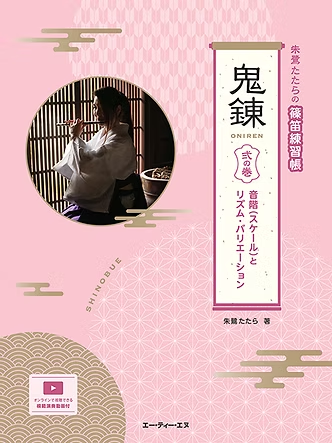 Shinobue books will often have titles like “The joy of shinobue” or “Gentle shinobue for everybody”. Then there's the reverse psychology way of appealing to customers: Toki Tatara's Oni-ren (“demon training”) drills carry the implication that if you survive these intense exercises from hell, your skill level will go up. But does either rationale necessarily follow?